Beats Explained

If you read comments in online writing groups, listen to podcasts, or read articles or blogs on the writing process, you’ve likely heard authors talk about beats.

A writer might say of a novel she’s planning, “I’ve written out the beats.” An author giving advice might mention the importance of beats.

If you’re not quite certain what a “beat” includes, you’re not alone. Having written multiple novels plus a book on story structure, it’s embarrassing to admit I didn’t really understand this word everyone was throwing around. Outlines, plot points, scenes, yes. “Beats,” no.

Happily, in this episode of How Story Works, author and story expert Lani Diane Rich explains beats.

First, she talks about a narrative unit, which is a series of events that has meaning. So a beat, a scene, and a story are all narrative units. Second, a beat is the smallest narrative unit. So scenes are made up of beats. Stories are made up of scenes.

Lani also illustrates exactly what a beat is and what it does, which is what I found most helpful. Using a scene from a work in progress, she pauses after every beat to discuss why it’s a beat and what it accomplishes or shows.

https://chipperish.com/2017/07/31/hsw-19-beats-all-the-way-down/

I hope this helps you plan or revise your own scenes and stories.

Until Sunday–

Best,

L.M. Lilly

Strong Characters And Stephen King

While being known as the Master of Horror, what many readers love about Stephen King is not how scary his books are but how he writes characters whose lives and stories matter. A great place to explore how King creates compelling and memorable characters is the Stephen King Cast.

The podcast explore and reviews each King book and often covers the movie adaptation as well in a follow-up episode.

I’m tempted to recommend two episodes about The Dead Zone because that’s my personal favorite of all of King’s novels. But an even better episode for learning about creating compelling characters is The Shining movie episode. (If you have time, listen to the book review episode as well.)

In The Shining movie review, the host of the Stephen King Cast compares the book and the movie. This comparison includes rating each major character in the book versus the same character in the movie, voting on which works better, and giving specific reasons why.

STEPHEN KING CAST THE SHINING (THE MOVIE)

What’s so valuable is that the Stephen King Cast host speaks as a reader and a viewer rather than as an author, as in the end it’s readers who decide what stories are most compelling.

Until Sunday, when I’ll talk about creating conflict through characters with competing goals.

Best,

L.M. Lilly

P.S. If you’re struggling with developing characters, you can also check out Writing As A Second Career’s Free Character Creation Tip Sheet for questions to ask yourself that might help.

Beyond The Bookstore

Most of us grew up when the only way to get books into the hands of readers was through bookstores or libraries.
While ebooks existed in the early 2000s in the form of PDFs and other files, the first Kindle wasn’t sold until 2007.

Because of that, a lot of writers, whether self-published, not yet published, or published by traditional print publishers, tend to think of bookstores and book signings as the main way to publicize books and meet readers.

That’s why I’m recommending this article from Amazon Author Insights. It includes seven tips for in-person book events that you might not have considered:

Promote Your Book Outside The Bookstore by Ethan Gilsdorf

Until Sunday–

Best,

L.M. Lilly

P.S. If you’ve tried any of them, or you do so in the future, please post your experience in the comments or send me an email: [email protected]

More On Kobo

Last Sunday, I wrote about why you might want to publish your book on Kobo, an ebook platform that’s very popular outside the U.S. (and is a favorite of independent bookstores in the U.S.).

I covered the major reasons I like selling my Awakening series on Kobo. In this podcast, Director of Self-Publishing and Author Relations Mark Lefebvre (who jokes his other name is “Mark from Kobo”) gives details on how Kobo works, talks about Kobo’s subscription service, and shares general marketing advice:


Mark also writes articles and blog posts on writing and publishing. In THE SMARTER ARTIST SUMMIT: A CONFERENCE FOR SMARTER INTROVERTS he talks about the 2017 Smarter Artist Summit and includes tips from many of the attendees.

Until Sunday, when I’ll talk about why managing your time is a bad idea.

Best,

L.M. Lilly

Top Sales Categories, Most Common Prices, Box Sets, And Other Useful Indie Sales Data

This Friday I recommend checking out Smashwords survey results for 2017 regarding sales by independent (self-published) authors. Smashwords is the world’s largest distributor of ebooks by indie authors.

The slides below summarize and show graphs of the survey results. Slides 29-30 show Top Categories for fiction sales on Smashwords (the top three are Romance, Erotica, and Fantasy) and non-fiction (top three are Self-Improvement; Health, Wellness and Medicine; and Business and Economics).

The slides also cover the most common prices ($2.99, but Free for Book 1 in a series), facts about box sets, the value of pre-orders, and the word counts of best selling books.

There was a little bit here that gave me pause, as a pie chart on Slide 32 shows of the Top 200 Best Selling Smashwords titles, 73% were Romance, which I don’t write, and only 1% mystery, and I just finished a first draft of Book 1 in a new mystery series.

But it’s important to look at more than one of the slides, and to look at the big picture. Despite the 1%, Mystery and Detective is No. 3 on the list of pre-order books capturing an outsize share of the market (Slide 78). Looks like I’ll be doing a pre-order of The Worried Man.

Until Sunday, when I’ll write about Kobo, an ebook publishing platform that can help you reach readers all over the world.

Best,

L.M. Lilly


Book Launch Tips

While I don’t write in either genre, I recently started listening to the Science Fiction and Fantasy Marketing podcast. The three hosts combined have a good mix of experience, as they’ve self-published, won awards, and had books traditionally published.

This particular episode grew from a snafu. The hosts planned an interview with Nate Hoffelder (of The Digital Reader blog) about recent publishing news. Some tech issues cut that short and made it hard to hear. So the hosts added a first segment where two of them  talked about their recent book launches.

SFFMP 137: Launching Books That Aren’t “to Market,” Agency Pricing, and Are Ebook Sales Down?

I loved that because they covered the challenges of marketing books that don’t fit perfectly in the more typical genres and sub-genres.

Other topics in this episode included:

  • ebook pricing
  • payments to authors for pages read of books in Kindle Unlimited
  • KU scams
  • ebook subscription services
  • the pluses and minuses of paperback and audiobook publishing

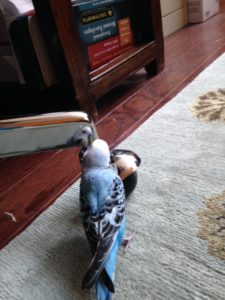
The Nate Hoffelder segment is a bit hard to decipher in spots. Also, I found his cockatiel chiming in a little distracting, despite myself being the proud owner of a very cute bird, parakeet Joss Whedon, shown here admiring himself–I mean, inspecting the chair leg in my office.

If you’re short on time, you may be tempted to skip that second segment. If you can fit it in while dealing with dishes or laundry or jogging, though, it’s worth it.

Until Sunday, when I’ll share my experiences using Scrivener to write non-fiction–

Best,

L.M. Lilly

Publishing Paperbacks: CreateSpace And Ingram Spark

If you are publishing your book yourself in print format, you’ll need to decide what publishing company to use.

This article by Karen Myers on the Alliance of Independent Authors website explains why some authors use two companies–CreateSpace for books sold on Amazon and Ingram Spark for other distribution outlets, such as Barnes and Noble.

Right now, paperback editions of my Awakening supernatural thriller series are published only through CreateSpace, but I’m thinking of adding Ingram Spark, as it appears from Myers’ article that bookstores will be more likely to carry the books. Note that you need to use your own ISBN (the number that identifies your book) with Ingram Spark, so you will spend a little more.

Until Sunday, when I’ll share some tips on book fairs.

Best,

L.M. Lilly

Children’s Books: To Self–Publish Or Not To Self-Publish?

Recently a friend asked me to review a children’s book she’d written and advise her whether to seek an agent or traditional publisher or to publish it herself. I don’t write children’s fiction myself, so I researched. I’m passing on what I learned for those of you who write for children or plan to do so.

To start with, I did try some children’s writing right after I graduated from college. For years I belonged to the Society of Children’s Book Writers and Illustrators. It remains a wonderful resource. The SCBWI hosts local and national events, has regional chapters, and offers information and articles through its website.


This 2016 article from Writer’s Digest lists agents looking for children’s books with directions on submitting. It’s a year old, so you’ll want to check each of agent’s website to see if the directions are still accurate, but it’s a great way to get started if you’d like to find an agent.

Here is an article on writing query letters to agents or editors regarding children’s books. (The article provides a good overview on queries for any writer.)

Finally, if you think you might want to get an illustrator, or if you’ve illustrated your own book, this article on self-publishing children’s books from Huffington Post provides useful information.

Until Sunday, when I’ll be writing about point of view as inspired by real life events between the current president of the United States and the former FBI director—

Best,

L.M. Lilly

P.S. If you’re in the Chicago area tomorrow (6/10/17), check out the Printers Row Lit Fest. You can find me and my books under the Chicago Writers Association tent on Dearborn Street just north of Polk Street in Chicago. There are tons of writers, books, and events, including many for children, throughout Saturday and on Sunday as well.

Topping The Charts

If you haven’t already done so, this Friday I recommend checking out Amazon Charts. For a long time, Amazon has made available best seller lists in multiple categories that are updated hourly. (For instance, you can click and find the Top 100 Free Occult Kindle books or the Top 100 Paid Reference books.)

Amazon Charts, though, is something different. It lists the Top 20 books for the week in four categories. Most Read Fiction, Most Sold Fiction, Most Read Non-Fiction, and Most Sold Non-Fiction. The lists include audiobook, paperback, and ebook sales on Amazon.

These companion lists allow for comparisons between what people are buying and what they are reading.

Until Sunday, when I’ll talk more about best seller lists–

Best,

Lisa


Earning A Living By Writing

If you’re wondering about how authors earn a living through self-publishing, author/entrepreneur Joanna Penn’s annual breakdown of her revenue will give you a place to start. Each year Joanna shares how her revenues break down by platform (such as Kobo v. Barnes & Noble v. Amazon), by type (fiction and non-fiction), by country, and by format (ebook, paperback, audiobook).

My Breakdown Of Book Sales By Format, Vendor, Genre, And Country. May 2016 – April 2017

This year, she also talks about box sets and selling direct. She ends with what she plans to do to earn more in the coming year.

I hope you find the post as fascinating and inspiring as I always do.

One of my goals is to earn enough this year that this type of breakdown of my revenues will be helpful to readers next January. For now, I’ll stick with recommending that you read Joanna’s.

Until Sunday–

Best,

L.M. Lilly