Why Business Matters For All Authors

Many writers choose to pursue the traditional route to publishing–getting an agent and/or publishing company–rather than publishing their own work because they want to focus on writing, not business. It’s important for all writers, though, to understand the basics about who is doing what for them, what rights they’re selling, and the parameters of deals being negotiated.

That’s why this Friday’s recommendation is an article by Kristine Catherine Rusch, an editor and writer who blogs about business issues for authors.

As Rusch’s examples of seeking reprint rights for anthologies she edited show, even if you’re not concerned about how much you earn, not knowing business can undermine how often your work is published and how many people read it.

Business Musings: Writers, Scam Artists, Agents, And More (Sigh)

Until Sunday–

Best,

L.M. Lilly

On Starting Your Own Small Press

Print-on-demand (or POD) publishing has made it far easier for authors to publish their own work. As I wrote about last Sunday in The Downsides Of Print On Demand Publishing, however, there are some drawbacks.

Also, some authors plan to publish not only multiple titles of their own, but to collaborate with others. That can make it more worthwhile to take a different approach to publishing.

For any of these reasons, or simply for the sake of comparison, you may want to learn more about adapting the methods of traditional print publishing for yourself. A great place to start is the following post from Joanna Penn:

From Indie Author To Small Press. Print Books, ISBNs, Branding And More

Have a great weekend.

Until Sunday–

L.M. Lilly

P.S. For more on print-on-demand publishing, check out my post Using KDP To Self Publish A Paperback.

Writing And Selling Short Stories

In 2016, Gregory Norris sold 54 short stories and 4 novellas. A full-time writer, Norris is interviewed on this week’s Self-Publishing Podcast.

Whether you plan to write short fiction or not, this Friday’s recommendation, Making Money with Short Stories with Gregory Norris, is well worth a listen. (If you want to skip the opening chitchat, start around 8:30, when Norris joins the podcast.)

Norris talks about paying markets for short fiction, writing a strong cover letter, how much you can earn at short stories, and how the form differs from novel writing.

Until Sunday–

Best,

L.M. Lilly

On Getting A Traditional Publishing Deal

I’ve had articles, short stories, and poems published traditionally, but a lot of my posts focus on self-publishing, as that’s how I’ve published my novels.

Because of that, I haven’t kept up as well as I’d like with current trends and practices of traditional publishers. To try to remedy that, I checked out this episode of the Self-Publishing Formula.

I hope you’ll find it as interesting and helpful as I did.

SPF-050 How to Land a Publishing Deal – with Alex Clarke, Headline Publishing


Best,

L.M. Lilly

What Does The Future Hold For Publishing?

In the 1990s, a friend told me he’d read an article that said in the future no one would buy books. Instead, people would have this amazing device that could turn into any book just by asking for it. That sounded impossible to me, and I didn’t connect it with the computer on my desk with its giant monitor, bulky processing unit, and dial up Internet connection that made odd pinging noises.

Yet here we are in 2017, and I both read books on Kindle and publish my novels in numerous ebook editions. (I still read paper books, too, as do many people, so that part hasn’t completely come true.)

Publishing seems to change by the minute, and advances like cars with built-in capacity for streaming audiobooks and virtual and augmented reality technology will no doubt will cause further evolution. So this Friday, my recommendation is the podcast/video episode from The Creative Penn on the future of publishing.

Enjoy!

Until Sunday–

Best,

L.M. Lilly

The Prosperous Writer’s Guide

This Friday, I’m recommending The Prosperous Writers Guide To Making More Money: Habits, Tactics, And Strategies For Making A Living As A Writer by Brian D. Meeks and Honorée Corder.

This book covers in a fun way why it’s important to understand the numbers involved in selling books. Also, and more importantly, the authors show you how to use those numbers to increase your sales. Focusing mainly on Amazon, the book helps you figure out whether the cost of an ad is worth it, whether your book description and cover are helping you sell your novel or hurting your chances, and how to choose keywords that can get your novel in front of the new readers.

Even if you are not yet publishing, or if your novels are published by a publishing company, it’s worth reading this book to better understand the factors that affect sales and how visible your novel will be on Amazon.

Much of the The Prosperous Writer’s Guide is helpful for other publishing platforms, too. The authors include tips on improving your book description and how to evaluate whether and how much overall sales have improved based on different ads or changes to your book description or cover.

I hope that’s helpful.

Until Sunday, when I’ll talk about the cost involved in creating an audiobook edition of your novel–

Best,

L.M. Lilly

Goodreads For Authors by Michelle Campbell-Scott

This Friday I recommend Goodreads for Authors, a book by Michelle Campbell-Scott. I love Goodreads as both a reader and author because it is all about books and is designed for, and filled with, readers. Step-by-step, Campbell-Scott walks you through how to use the social media platform.
The book tells you how to sign up on Goodreads, add or start a blog there, claim your author profile, review books, meet people, and set up ads, among many other things. If you’re already familiar with Goodreads, as I was when I read the book, you can easily skip to the parts you still need to learn. I encourage you not to do that, though, and instead to read the entire book. It’s a fast read, and Campbell-Scott is very thorough, so you may discover facets of the platform you missed on your own.

I listened to Goodreads for Authors on Audible. While that worked fine, I wished I’d bought the book instead so I could more easily flip or scroll to review certain sections. Also, there are links and checklists in the book that I would have found easier to use in ebook or paper form. If you’re too busy to read another book, though, and might be able to fit it in on audio, definitely do so. You’ll still get a lot out of it.

Until Sunday, when I’ll do an overview of how I interact on social media as an author–

Best,

L. M. Lilly


The Easy Way To Track Kindle Sales For The Life Of Your Books

This Friday’s recommendation is Book Report. If you sell ebooks on Amazon, or you plan to do so, it’s a simple way to track sales and earnings over the lifetime of each book.

Without it, you can still easily see 90 days of sales on the Kindle Direct Publishing Dashboard. But the only way to figure out sales and earnings over the entire life of your books is to manually open multiple reports and tally the numbers yourself.

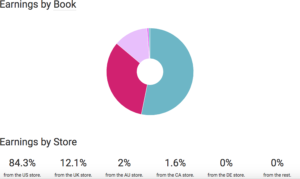
Last October I did that for the first book in my supernatural thriller series, The Awakening. That was tedious and took a long time, though I was happy to learn that I’d sold nearly 10,000 copies. Had I had Book Report, I could have done it for Kindle sales just by clicking a button. Book Report also shows a piechart of sales and earnings per book and by Amazon company (US versus UK versus Canada, etc.).

Here’s the pie chart and the percentages by store for my Kindle ebooks. (The Awakening, Book 1, which has been out the longest, is the biggest slice of pie.)

Book Report is available free to anyone earning less than $1,000 per month through KDP. If you earn more than that, first, kudos to you, and second, it will be only $10 a month, but you can try it free for two weeks–without needing to enter credit card information now. Click on this link if you’d like to try it.

I hope that’s helpful.

Until Sunday-

Best,

L. M. Lilly


What Does The Weekend Mean For You?

Weekends are supposed to be a time to relax, yet most of us find them filled with all the responsibilities and tasks we didn’t get to during the week. When you’re also fitting writing into your schedule and/or you have a career that requires working weekends some or all of the time, that can add to the pressure. Instead of relaxing, you’re stressing more because you’re not relaxing.

That’s why this Friday I’m recommending an episode of The Petal To The Metal where two authors talk about weekend time and the balance between enjoying life and getting things done. I was drawn to this because they offer tips and alternate perspectives and acknowledge that there’s no one-size-fits-all answer. As I noted in Tips For Writing Novels While Working More Than Full Time, not everyone can follow generic advice (like get up an hour early, write every day, or write during your lunch hour). But that doesn’t mean you can’t finish a novel or that you shouldn’t enjoy life while you do.

http://thepetaltothemetal.com/ep006/


Until Sunday–

Best,
L. M. Lilly

If At First You Don’t Succeed: Iterate and Optimize

This Friday I’m recommending a book that’s a quick read with a mix of inspiration and business advice for writers: Iterate and Optimize: Optimize Your Creative Business for Profit by Sean Platt, Johnny B. Truant, and David Wright of the Self Publishing Podcast.

What I like most about it is that it encourages writers to get started or to grow their business rather than being frozen by indecision and concern about doing the “wrong” thing.

Under this philosophy, let’s say you finished a novel you’re pretty happy with. You spent the last two years writing and revising in the early mornings and a few weekends carved out of your other job or profession. Rather than spending two more years tweaking it for fear of rejection or bad reviews, the Iterate and Optimize approach encourages you to start querying agents or to publish it yourself and to get on with your next novel. If you get rejections on the first, or it isn’t as well-received as you hoped, or you discover six months from now that the cover you got fairly cheaply doesn’t match your target market, you can both improve and update the first novel and use what you learned in your second.

The book also provides a lot of solid information not only about self-publishing but about growing a business. Even if you’re planning to stay focused on your current career and write on the side, and so feel you don’t need to worry about the business, this is worth a read. It’s quick and interesting and will give you context for the ever-changing publishing world where your books will live.

The Amazon blurb and the book itself suggest reading the authors’ Write. Publish. Repeat. first. I haven’t read it, so I can only say I got a lot out of Iterate and Optimize without having done so, though it’s possible I missed something in the process.

Until Sunday —

Best,

L. M. Lilly