Querying Agents

Earlier this month I attended ThrillerFest in New York. Part of the conference covered the quest to find a literary agent.

All the agents stressed keeping the query short, clear, and to the point. One agent described the perfect query letter (now usually sent as an email) as having three parts and only three parts:


  1. The Hook
  2. The Book
  3. The Cook
 The Hook

The hook is the aspect of your story that grabs the reader. It’s often a single sentence.

Some writers use a what if statement/question. For Stephen King’s Carrie, it might go like this:

What if a bullied girl develops superpowers and seeks revenge?

The hook also can refer to familiar books or movies. For the blockbuster movie Alien, the hook was Jaws in space. For my Awakening series, I often say Rosemary’s Baby meets The Da Vinci Code.

The Book

The description of the book should be 1-2 paragraphs, so think about what would be on the inside flap or back cover of your book in the bookstore.

Three points main points are your protagonist, the protagonist’s actions, and the force(s), person, or people who oppose your protagonist.

Including the opposition is important because story is about conflict. The protagonist should be active because a passive main character makes for a dull book.

Including more about the main character matters because that’s what draws readers in. Even in genre and commercial novels, which typically are more plot-oriented than literary novels, readers become engaged only if they care about the character.

For an example, see the description of the first Ruth Galloway mystery by Elly Griffiths. The description covers the plot, which revolves around the finding of a child’s bones and a kidnapping, but it also tells us a lot about Ruth Galloway, a forensic archaeologist who lives “happily alone” in a remote area.

Ruth is what drew me in and keeps me reading the books.

Look at online descriptions of books in your genre and use them as examples if they make you want to read on and especially if they prompt you to buy the book.

For more on how to describe your novel, you can check out Bryan Cohen’s How To Write A Sizzling Synopsis.

The Cook

Your query should include a sentence or two about you. List previous publications, if any, and other relevant experience. Obvious examples are if you’re writing a police procedural and you are a police officer or forensic pathologist or you’re a lawyer writing a legal thriller.

If you don’t have a long list of publications or specific experience, it’s worth mentioning any degree or technical experience that shows you can follow through on projects and have a background that will provide material for future books. Agents are not looking simply to represent a single book but for writers with a long career ahead of them.

Regarding previous publications, I heard conflicting advice at ThrillerFest on self published titles.

One agent said not to mention it and just to let it “come out” if the agent shows interest. (He claimed he wasn’t negative about self publishing. Uh, maybe you are?)

Another viewed it as fine to include though largely irrelevant.

A third found it encouraging that I’d published a four-book series because it showed an ability to produce work consistently.

I think the best advice is that if you have a series, it’s worth mentioning for that reason. If you’ve published books with at least forty or fifty reviews, you might list them as well, as it shows people are reading your work. On the other hand, if you’ve self published a book and it only has a couple reviews, that probably won’t add anything to your resume in the agent’s eyes.

In Closing

Your closing paragraph should state what you’re enclosing, if anything. For example, if that agent’s submission guidelines call for it, include sample pages. Also thank the agent for her or his time. (It always helps to be polite.)

Two final tips:

  1. Make sure you check the agent’s guidelines, which are usually available online. Some agents want sample pages to be copied into the email, others want an attachment in Word. While following the guidelines precisely won’t guarantee a positive response, violating them will probably get you screened out.
  2. Take a break after finishing your query. Come back in an hour–or better yet a day–and proofread your query before sending it.

In summary, write a short query that includes the hook, the book, and the cook. Be polite, proofread, and follow the agent’s guidelines.

Until Friday, good luck–

Best,

L.M. Lilly

P.S. For more on finding the right writer’s conference for you, check out last Sunday’s post Choosing A Writing Conference.

Beyond The Bookstore

Most of us grew up when the only way to get books into the hands of readers was through bookstores or libraries.

While ebooks existed in the early 2000s in the form of PDFs and other files, the first Kindle wasn’t sold until 2007.

Because of that, a lot of writers, whether self-published, not yet published, or published by traditional print publishers, tend to think of bookstores and book signings as the main way to publicize books and meet readers.

That’s why I’m recommending this article from Amazon Author Insights. It includes seven tips for in-person book events that you might not have considered:

Promote Your Book Outside The Bookstore by Ethan Gilsdorf

Until Sunday–

Best,

L.M. Lilly

P.S. If you’ve tried any of them, or you do so in the future, please post your experience in the comments or send me an email: [email protected]

Choosing A Writing Conference

If you’re working full time (or more than full time) at another profession while writing, it can be a tough call to devote your a week off to a writing conference. It is worth it, though, if you can enjoy the time away from your usual work, learn about writing craft or business, and meet writers and other people who may help your writing journey.

If you write suspense, mysteries, or thrillers, one that should be at the top of your list is the annual ThrillerFest in New York.

It meets three important criteria for a writing conference:

  1. Good Location (as in one you’d want to visit if you were taking a “real” vacation)
  2. Quality Content
  3. Helpful and Friendly People
Location – New York

First–New York.

I love visiting the city. There is energy in the air. There are wonderful wine and cheese bars. There are books everywhere. Once I passed a psychology institute on the way to a restaurant, and there was a cardboard box of free books left there for any passers-by to take.

I also always love returning home, as it makes Chicago’s downsides–traffic, air quality, crowds–seem so very livable by comparison. (Sorry, NY.)

The library is a great place to tour.

The museums are fantastic. This time I visited The Brooklyn museum, which had a Georgia O’Keefe exhibit and an exhibit that was focused on the color blue. In that one, I learned that Nemesis was a goddess who punished people whose good luck made them overconfident. Who knew.

Content In Three Parts

ThrillerFest has three parts plus. There is CraftFest, where you can learn in smaller sessions about specific writing issues. For instance, I attended mystery author Hallie Ephron’s talk on the Web of Character. (More on that in a future article.)

Next is Pitchfest, where you can pitch your novel to agents and editors. This part starts with a talk the night before on preparing your pitch, which is mainly getting it down to about 25 words. The next day in a large conference room you have a chance to practice your pitch on established authors and agents and get feedback.

Sidewalk sale at The Strand bookstore

After that, you find the agents and editors you want to pitch in three or four smaller rooms by alphabetical order. You wait in line (usually 1-3 people ahead of you) to sit at a small table and tell them about your book.

To a person, I found them helpful to talk with, and the questions they asked about the work aided me not only in getting across why I thought they might be interested but in further refining my plot. (I was pitching my mystery novel in progress.)

Pitchfest also included the No Pitch Zone.

For two hours, several agents who were not accepting pitches were available to look over query letters and first pages. The agent I talked with struck two lines out of my page one that confused her.

That in itself was invaluable. The lines made perfect sense to me. But if she was lost, other readers will be too, and the last thing I want is for a reader to say Huh? on the second paragraph and walk away. (I hope my beta readers would have noticed the same line, but since they’ll be looking at the novel as a whole, they might not focus so specifically one page.)

Finally, the actual ThrillerFest portion includes multiple panels of well-known authors and speakers. Topics are as diverse as hostage negotiation (with an FBI negotiator), women’s roles in thrillers, writing gruesome horror, and marketing. (See this year’s schedule here.)

The fest ends with a dinner where the 2017 award winners are announced.

People

Volunteers, presenters, agents, coordinators–all were helpful and fun to talk with. The agents must get weary by the end of the second hour, yet each one smiled and took time to talk with me as if I were the first person rather than the fiftieth.

Attendees also were friendly.

It was easy to introduce myself to others and start chatting. This seems like it ought to be a given. After all, we’re all there because we love to write. But I’ve been to conferences where I said hello to someone in line and received a blank stare in response, or where I went to the evening dinner and all my attempts at conversation fell flat. At ThrillerFest, everyone acted happy to meet someone new.

The presenters, too, were accessible and willing to answer questions after sessions. I got good advice on where to seek an agent regarding trying to turn The Awakening series into a video series (such as on Netflix or through the other companies entering that space).

If you decide to attend next year, I recommend volunteering. While you don’t get a discount on the price, it’s a great way to meet people, all of whom I found to be friendly and fun. It also gives you the chance to hear inside stories from people who sold their books through contacts made at the conference.

In the coming weeks, look for posts on what I learned about pitching and in the craft sessions.

Until Friday–

Best,

L.M. Lilly


Books That Become Movies

Every novelist dreams of having a book made into a movie. The article 21 Thriller Novels That Had Adaptation Deals Before Publication, which appears on BookBub, describes novels that garnered film deals before the books were published. The 21 thrillers include recently-released, soon-to-be-released, and classic films (such as Jaws).

Reading each plot description can help you spot what draws readers and viewers in so you can use it in your own book descriptions, whether you’re writing sales copy or query letters.

Also, I found that how I reacted –as in either “that’s my type of book” or “not for me”–to certain words and phrases showed me which ones signal what type of thriller. (I ruled out the spy thriller until I saw Jennifer Lawrence will be starring it. I’ll pretty much watch anything she’s in.)

Finally, as a whole this list provides a good overview of what types of concepts and characters intrigue Hollywood.

https://media.bookbub.com/blog/2017/07/10/book-to-movie-thrillers-that-had-deals-before-publication/


Until Sunday, when I’ll talk about attending the Craftfest part of Thrillerfest in New York and pitching to agents.

Best,

L.M. Lilly

Set A Single Goal (And Stop Managing Your Time)

Time management gives me the chills.

When I’d been a lawyer for about three years, the large law firm where I worked sent an email about a time management seminar. A slow week for me was working 55 hours, and I was writing a novel on the side.

I saw the email and literally thought, “I don’t have time.”

Plus, the description reminded me of something I read once about stress management seminars. Most people attend not to lessen stress but to learn to take on more of it. This seminar sounded like a way for my firm to teach me to cram more into my schedule.

No thanks.

But can you cram in less and get more done?

The best way I’ve found to do that is to set a single overarching goal for the year.

The Single Goal

Choosing one major goal for the year creates time.

Most articles and advice about goals stresses ensuring that by a certain time or after certain steps, you’ll achieve something measurable. As an example, simply stating that my goal is writing a novel, particularly if I tell other people and add a time frame (such as “within a year”), makes it more likely I’ll do it.

But that’s only part of the benefit. An overarching goal helps you make the best use of the limited time you have and, more important, causes you to spend less time on tasks that won’t get you where you want to be and don’t add to your enjoyment of life.

Without goals, we can check things off To Do lists all day and feel like we’re accomplishing a lot without achieving what we truly want in life.

How Making One Decision Creates Time

No one schedules time to stare at a blank screen or an overflowing To Do list feeling overwhelmed. It just happens, and it not only takes up time, it undermines us. We feel less able to get things done and less sure we’ll reach our goals.

That in turn takes more time as we mentally reevaluate whether we set the right goal, whether we have time for this whole writing thing anyway, and whether we’d be happier focusing on something else.

Choosing a single main goal for the year eliminates those countless minutes (which eventually add up to hours).

Let’s say your overarching goal for the year is to finish one novel. That doesn’t mean you can’t write anything else. But your time split for writing will be 80/20 or 90/10 in favor of the novel. Not a short story or article or blog post. You do those things if you feel good about your progress on your novel for the week or month, but the novel comes first.

In other words, if you only have 20 minutes, you know what you’re working on.

Or let’s say you have books published and your main goal is to increase your earnings. You’ll still need to write, but you will need to devote significant time to business pursuits. You’ll probably do a 50/50 split between writing and business.

That’s where I am this year. My overarching goal is to earn $50,000 in gross income from royalties by the end of the year, which is a significant increase for me. (I wrote it on this index card to remind me.) To pursue this, I’m splitting my time equally between writing and business.

Breaking It Down

You’ll still need to know what to do with each small segment of time, especially if you have many other responsibilities and are likely to have only short bursts of time to write.

The single goal gives you the framework. Once you set it, break it down.

For the novel example, if you’re starting from zero, depending on your own writing process the pieces might be:

  • Characters
  • Plot/Outline
  • Scenes
  • Organizing Scenes Into Chapters
  • Revisions Of Plot
  • Revisions Of Dialogue
  • Copyediting

Now if you have 15 minutes, you can start on the next task on the list. In 15 minutes, you can write a few paragraphs or sketch out bullet points about a character (try my free Character Creation Tip Sheet for some questions to ask yourself). You can figure out one major plot point. If you’re standing in line for groceries, you can imagine a single scene in your mind so that when you get the next 15 minutes you can start writing it.

For me, if I have 15 minutes, I might watch a section of the Ads For Authors course I’m taking or listen to 15 minutes of a marketing podcast or research the latest book promotion sites by running a quick Google search.

Focus

The single goal also ensures you focus on what matters. If you’re like me and you like goal setting and lists (I love lists), you’ll probably set other goals for the year or month, and that’s good. You can see the top of my monthly goal sheet in the photo below the index card.

Your single major goal will help you decide if those other goals make sense. It also will aid you in knowing which to omit if you’ve taken on too much and which to push toward regardless.

On a task level, the single goal keeps you on track. If I’m tempted to check my KDP Dashboard (which shows book sales updated periodically) for the third time in a day, I look at my index card and ask myself if doing so will help me increase my royalties to $50,000.

The answer, all but perhaps once a week to see how different promotional efforts or ads worked, is No. Same for randomly checking Twitter.

All of the above isn’t to say that you can’t have any time where you are relaxing and not being productive in a work sense, where you’re spending time with your family or friends or reading a book. We all need that or what’s the point of life?

The single goal helps you focus and use all your time well, including short bursts of it, giving you more free blocks of time for other parts of life.

Rather than time being an unruly employee to manage or an enemy to overcome, it becomes your ally.

And who doesn’t need more allies?

Until next week—

Best,

L.M. Lilly

More On Kobo

Last Sunday, I wrote about why you might want to publish your book on Kobo, an ebook platform that’s very popular outside the U.S. (and is a favorite of independent bookstores in the U.S.).

I covered the major reasons I like selling my Awakening series on Kobo. In this podcast, Director of Self-Publishing and Author Relations Mark Lefebvre (who jokes his other name is “Mark from Kobo”) gives details on how Kobo works, talks about Kobo’s subscription service, and shares general marketing advice:


Mark also writes articles and blog posts on writing and publishing. In THE SMARTER ARTIST SUMMIT: A CONFERENCE FOR SMARTER INTROVERTS he talks about the 2017 Smarter Artist Summit and includes tips from many of the attendees.

Until Sunday, when I’ll talk about why managing your time is a bad idea.

Best,

L.M. Lilly

Publishing Your Book On Kobo

There are many platforms on which you can self publish your novel as an ebook. I publish on Amazon (for Kindle), Kobo, iBooks. GooglePlay, and Nook.

Whenever I tell people that, though, the next question, at least in the U.S., usually is “What is Kobo?”

Kobo eReaders and Reach

With apologies to Kobo (as no one likes to name the competition), I sometimes tell non-writing friends in the U.S. that it’s Kindle in Canada. But that’s not quite true.

Kobo sells books all over the world. After publishing on Kobo, I sold books in countries I was unfamiliar with before that, such as Wallis & Futuna.

The map to the right shows the countries where Kobo ebooks in my Awakening series have been bought.
Books for Kobo can be read on Kobo ereaders or on Kobo apps, which are listed on Kobo’s website.

The Pluses of Kobo

There are lots of reasons to love Kobo.

Books Books Books: Unlike Amazon, Kobo sells only books and ereaders. No one goes to Kobo to buy a HEPA air filter or a ceiling fan or a pair of sneakers. If someone is on Kobo’s website, it’s to buy books. I suspect that influences the next two pluses.

Kobo readers review more books. On Amazon, roughly .01% of readers who bought The Awakening reviewed it. If I count not only sales but the tens of thousands of free downloads, the ratio is crazy low.

On Kobo, in contrast, over 40% of those who bought The Awakening reviewed it.

I also get a higher read through rate on Kobo. I particularly notice this with The Awakening (Book 1) being free. Everything I’ve read and my own experience says that on Kindle, many many free books are downloaded and never read. Based on the read through rate, Kobo readers appear far more likely to read a free book and, if they like it, to buy the next book.

If you’re unfamiliar with the term, the read through rate is the percentage of people who buy Book 2 in a series after reading Book 1. While you can’t tell exactly who bought, you can see the numbers. For simplicity’s sake, let’s say over the last three months you sold 100 of Book 1 and 50 of Book 2. That would be a read through rate of 50%.

Royalties: As of this writing, for books above $9.99, the royalties are more favorable to authors on Kobo. Most platforms pay a lower royalty (usually around 30%) for books under $2.99 and 65% or 70% on books above $2.99, but drop the royalty rate if the sale price exceeds $9.99.

Kobo doesn’t do that. The percentage remains the same for all books at $2.99 and up.

This is very helpful for box sets. If you have a 7-book series you’re selling as a bundle or box set for $12.99, your royalty would still be 70% on Kobo rather than dropping to a lower percentage.

Promotion: Kobo allows you to offer your ebook free. While it seems counterintuitive, if you have a series, providing your first book free can be a good way to draw readers in, resulting in higher earnings overall. (I’ve had my best three sales months ever this year after switching The Awakening to free.) And even if the earnings are the same, you’ve expanded your reader base.

Amazon will only list your ebook free to price match other platforms. Occasionally this happens automatically, but often you need to request it, and the response always includes a reminder that Amazon is not obligated to let you offer the book free.

Kobo also has on its dashboard options for promotions, including some priced as low as $5. I don’t see huge sales spikes on the days of these promotions, but they help sales for a long time, sometimes for a month or more.

Technology: Kobo’s technology is easy to use. Once you create an account, which is free, you are walked through five simple steps to upload your book. Kobo accepts epub files—the same sort of file accepted by all platforms I’ve used except Amazon. (Amazon requires a mobi file.)

Kobo sales data is easy to see and read. The dashboard, which is where you see your sales information, shows your dollars earned and books sold for the current month and for all time. You can use drop down menus to filter by book.

Author Support: Kobo sends a monthly newsletter with tips for writers. Kobo also has a podcast for authors and very helpful support via email.

Downsides of Kobo (But Not Really)

The only downside of Kobo that I can think of is not intrinsic to Kobo. It’s that Amazon offers many incentives to authors to sell their ebooks exclusively for Kindle. As this is a post about Kobo, I won’t go into those pluses here.

The concern with being exclusive to Amazon is that it’s putting all your eggs in one basket. If you’re working a day job you’re happy with or have another career you enjoy and don’t want to leave, that may be fine.

If you’re striving to earn your living by writing, that’s a tougher call. On the one hand, some authors earn monthly royalties I only dream of through being exclusive to Amazon.

On the other, should Amazon change their incentives or get rid of certain programs completely, those authors could see their earnings drop precipitously. They’d adapt I’m sure, but it would be a challenge. To me, it would be like being a freelancer with only one client. It’s not necessarily a bad idea, but it’s important to be aware of the risk.

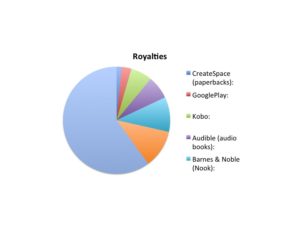
I have my series wide–i.e., I published it on various platforms–and have other ebooks exclusive to Kindle. To give you an idea of earnings per platform, for this year, here’s how my royalties break down into percentages:

1.5% CreateSpace (paperbacks)

3% GooglePlay

6.5% Kobo

7% Audible (audio books)

10.5% Barnes & Noble (Nook)

11.5% Apple (iBooks)

60% Amazon (Kindle)

Keep in mind that your breakdown might be completely different. For me, obviously Amazon is the largest part of what my books earn. (It’s actually 68.5, as CreateSpace and Audible are Amazon-related companies). But I would definitely miss the rest. And should Amazon suddenly change things up, I haven’t cut into all my income.

Questions about Kobo or going wide? Please post them in the comments.

Until Friday—

Best,

L.M. Lilly

P.S. After writing this post, I came across more great information on Kobo straight from the Director of Self-Publishing and Author Relations, Mark Lefebvre. See Friday’s appropriately-titled recommendation More On Kobo if you want to know more.

Top Sales Categories, Most Common Prices, Box Sets, And Other Useful Indie Sales Data

This Friday I recommend checking out Smashwords survey results for 2017 regarding sales by independent (self-published) authors. Smashwords is the world’s largest distributor of ebooks by indie authors.

The slides below summarize and show graphs of the survey results. Slides 29-30 show Top Categories for fiction sales on Smashwords (the top three are Romance, Erotica, and Fantasy) and non-fiction (top three are Self-Improvement; Health, Wellness and Medicine; and Business and Economics).

The slides also cover the most common prices ($2.99, but Free for Book 1 in a series), facts about box sets, the value of pre-orders, and the word counts of best selling books.

There was a little bit here that gave me pause, as a pie chart on Slide 32 shows of the Top 200 Best Selling Smashwords titles, 73% were Romance, which I don’t write, and only 1% mystery, and I just finished a first draft of Book 1 in a new mystery series.

But it’s important to look at more than one of the slides, and to look at the big picture. Despite the 1%, Mystery and Detective is No. 3 on the list of pre-order books capturing an outsize share of the market (Slide 78). Looks like I’ll be doing a pre-order of The Worried Man.

Until Sunday, when I’ll write about Kobo, an ebook publishing platform that can help you reach readers all over the world.

Best,

L.M. Lilly


Scrivener (Tools of the Writing Trade No. 1)

Recently I tried Scrivener, a new software (at least new to me) for writing.

I started word processing when I worked during college. I temped at different companies, and I learned many word processing programs. (Word Star, anyone? Yes, that long ago.)

Of them all, Microsoft Word emerged as the winner in the business and legal worlds.

In my view, Word was clearly not the best, but because I used it for legal work, I used it for my other writing, too. No sense in confusing my finger/brain connections with multiple programs.

Now, though, once again you can choose from many other options.

In this post, I’ll talk about Scrivener.

Scrivener – Software For Writers

Over the last year, I kept hearing about Scrivener. In blog posts and podcasts, writers raved about it having been created specifically for writers and about its organizational features.

After using it for a 30-day trial, I bought it for Mac for about $40. I mostly used it to create blog posts, but kept writing novels in Word.

Recently, though, I started writing a non-fiction book (on creating characters) in Scrivener. I discovered I love the program.

Here’s why:

Non-sequential writing

I tend to write novels in order. I begin with a rough outline of five plot points, then I write from point to point. When I rewrite, I mostly do that in order as well, or I’m searching for specific character names or scenes.

Word works fairly well for that, though once the document gets past 50,000 words, I sometimes see certain functions (such as Spell Check) failing.

With non-fiction, it’s not always obvious what topics should come first. My topics on character creation include, among many others, how the character handles confrontation, how the character defines family and who belongs to it, personality traits, and impressions others have of the character.

Some topics lend themselves to entire chapters, others to a paragraph. I don’t always know which until I start writing.

With Scrivener, I can open a folder, label it by a topic name, and start writing, then create another folder and another. The names appear on the left, so I can easily see the topics.

I can also easily rearrange them with a click and drag. That, for me, is the best feature.

What you’ll see


Scrivener offers display options Word doesn’t, including a corkboard with index cards. With a click of a button, I can see my topics as if they were pinned to the corkboard.

I can rearrange them on the corkboard, too, again by clicking and dragging.

Organization

The folders are the equivalent of chapters. You can write directly in the folder. You can also create sub-sections under the chapters. It’s easy to switch a topic from a folder to a sub-section or to rearrange within a folder.

This is wonderful if you hit a point where you realize that a topic you thought you could cover in a couple sentences actually requires a few pages and its own chapter.

Research and notes

The right side of the screen allows you to enter all kinds of information, such as research or notes, that won’t appear in the manuscript but will be easy to access.

Referring to other documents

Scrivener allows splitting the screen.

You can view two different documents, such as an outline and the manuscript. Or you can view two different parts of the same document. This is particularly nice if you need to edit a section that may be repetitive or that refers to a previous or later chapter.

30-day trial period

You can download a 30-day trial version of Scrivener. The best part of that is that, at least when I downloaded it, that meant 30 days of use.

So if I worked on a manuscript for two days, then had a week where my law practice took up all my time, I’d only used two days of the trial, not nine.

Affordability

As I write this, Scrivener costs between $35 and $45 (a bit more if you want it for Mac and PC both).

The Downsides Of Scrivener

Scrivener does have some challenges.

For one thing, you will definitely want to use the tutorial. At least, I definitely did. While you can learn a lot by playing with different features, I don’t find the icons or the menus particularly intuitive.

In fact, I struggled a lot with certain features. Once I did the tutorials, they seemed easy.

Also, while Scrivener is available for Mac and PC, I’ve heard that it’s not quite as amazing for PC. It’s a good enough program that if you have a PC, though, I still encourage you to try it out. My guess is that it’s still much better than Word for long documents.

Have you tried Scrivener? If so, please share you experiences in the comments.

Until Friday–

Best,

L.M. Lilly

P.S. For software that will convert your files into ebook and print formats for publishing, see Using Vellum To Create eBooks And Paperbacks.

Book Launch Tips

While I don’t write in either genre, I recently started listening to the Science Fiction and Fantasy Marketing podcast. The three hosts combined have a good mix of experience, as they’ve self-published, won awards, and had books traditionally published.

This particular episode grew from a snafu. The hosts planned an interview with Nate Hoffelder (of The Digital Reader blog) about recent publishing news. Some tech issues cut that short and made it hard to hear. So the hosts added a first segment where two of them  talked about their recent book launches.

SFFMP 137: Launching Books That Aren’t “to Market,” Agency Pricing, and Are Ebook Sales Down?

I loved that because they covered the challenges of marketing books that don’t fit perfectly in the more typical genres and sub-genres.

Other topics in this episode included:

  • ebook pricing
  • payments to authors for pages read of books in Kindle Unlimited
  • KU scams
  • ebook subscription services
  • the pluses and minuses of paperback and audiobook publishing

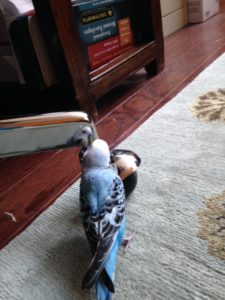
The Nate Hoffelder segment is a bit hard to decipher in spots. Also, I found his cockatiel chiming in a little distracting, despite myself being the proud owner of a very cute bird, parakeet Joss Whedon, shown here admiring himself–I mean, inspecting the chair leg in my office.

If you’re short on time, you may be tempted to skip that second segment. If you can fit it in while dealing with dishes or laundry or jogging, though, it’s worth it.

Until Sunday, when I’ll share my experiences using Scrivener to write non-fiction–

Best,

L.M. Lilly