Earlier this month I attended ThrillerFest in New York. Part of the conference covered the quest to find a literary agent.

All the agents stressed keeping the query short, clear, and to the point. One agent described the perfect query letter (now usually sent as an email) as having three parts and only three parts:
- The Hook
- The Book
- The Cook
The Hook
The hook is the aspect of your story that grabs the reader. It’s often a single sentence.
Some writers use a what if statement/question. For Stephen King’s Carrie, it might go like this:
What if a bullied girl develops superpowers and seeks revenge?
The hook also can refer to familiar books or movies. For the blockbuster movie Alien, the hook was Jaws in space. For my Awakening series, I often say Rosemary’s Baby meets The Da Vinci Code.
The Book
The description of the book should be 1-2 paragraphs, so think about what would be on the inside flap or back cover of your book in the bookstore.
Three points main points are your protagonist, the protagonist’s actions, and the force(s), person, or people who oppose your protagonist.
Including the opposition is important because story is about conflict. The protagonist should be active because a passive main character makes for a dull book.
Including more about the main character matters because that’s what draws readers in. Even in genre and commercial novels, which typically are more plot-oriented than literary novels, readers become engaged only if they care about the character.
For an example, see the description of the first Ruth Galloway mystery by Elly Griffiths. The description covers the plot, which revolves around the finding of a child’s bones and a kidnapping, but it also tells us a lot about Ruth Galloway, a forensic archaeologist who lives “happily alone” in a remote area.
Ruth is what drew me in and keeps me reading the books.
Look at online descriptions of books in your genre and use them as examples if they make you want to read on and especially if they prompt you to buy the book.
For more on how to describe your novel, you can check out Bryan Cohen’s How To Write A Sizzling Synopsis.
The Cook
Your query should include a sentence or two about you. List previous publications, if any, and other relevant experience. Obvious examples are if you’re writing a police procedural and you are a police officer or forensic pathologist or you’re a lawyer writing a legal thriller.
If you don’t have a long list of publications or specific experience, it’s worth mentioning any degree or technical experience that shows you can follow through on projects and have a background that will provide material for future books. Agents are not looking simply to represent a single book but for writers with a long career ahead of them.
Regarding previous publications, I heard conflicting advice at ThrillerFest on self published titles.
One agent said not to mention it and just to let it “come out” if the agent shows interest. (He claimed he wasn’t negative about self publishing. Uh, maybe you are?)
Another viewed it as fine to include though largely irrelevant.
A third found it encouraging that I’d published a four-book series because it showed an ability to produce work consistently.
I think the best advice is that if you have a series, it’s worth mentioning for that reason. If you’ve published books with at least forty or fifty reviews, you might list them as well, as it shows people are reading your work. On the other hand, if you’ve self published a book and it only has a couple reviews, that probably won’t add anything to your resume in the agent’s eyes.
In Closing
Your closing paragraph should state what you’re enclosing, if anything. For example, if that agent’s submission guidelines call for it, include sample pages. Also thank the agent for her or his time. (It always helps to be polite.)
Two final tips:
- Make sure you check the agent’s guidelines, which are usually available online. Some agents want sample pages to be copied into the email, others want an attachment in Word. While following the guidelines precisely won’t guarantee a positive response, violating them will probably get you screened out.
- Take a break after finishing your query. Come back in an hour–or better yet a day–and proofread your query before sending it.
In summary, write a short query that includes the hook, the book, and the cook. Be polite, proofread, and follow the agent’s guidelines.
Until Friday, good luck–
Best,
L.M. Lilly
P.S. For more on finding the right writer’s conference for you, check out last Sunday’s post Choosing A Writing Conference.
 Most of us grew up when the only way to get books into the hands of readers was through bookstores or libraries.
 When I’d been a lawyer for about three years, the large law firm where I worked sent an email about a time management seminar. A slow week for me was working 55 hours, and I was writing a novel on the side.
 That’s where I am this year. My overarching goal is to earn $50,000 in gross income from royalties by the end of the year, which is a significant increase for me. (I wrote it on this index card to remind me.) To pursue this, I’m splitting my time equally between writing and business.
 The map to the right shows the countries where Kobo ebooks in my Awakening series have been bought.
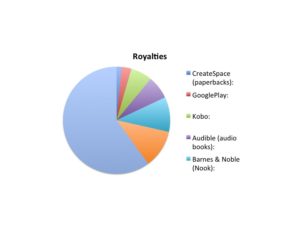 1.5% CreateSpace (paperbacks)
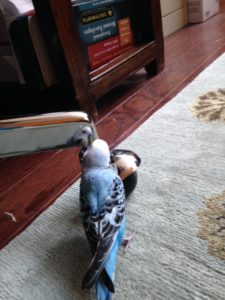 The Nate Hoffelder segment is a bit hard to decipher in spots. Also, I found his cockatiel chiming in a little distracting, despite myself being the proud owner of a very cute bird, parakeet Joss Whedon, shown here admiring himself–I mean, inspecting the chair leg in my office.
 a friend suggested I have a spinner where people could win prizes, as everyone likes to play games and win things. I was skeptical, but the night before the fest, I went to Target, bought a cheap game of Twister, and modified the spinner.
 I typically buy half a table for a few hours under the Chicago Writers Association tent. That tent is one of many set up in the center of the main street at the fair. (This photo shows the afternoon before the book fair.)