3 Readers You Need Before You Publish Your Novel

Three types of readers are key to preparing your novel for publication. These readers become part of the process after you have made all your revisions.

Their purpose is to be sure your final product doesn’t contain errors that will distract from the story.

Who are they?

  • Continuity readers
  • Subject matter experts
  • Proofreaders

Consistency Is Key

A continuity reader makes sure that your writing is consistent. You ask this person, ideally someone who has not read any previous drafts of your book, to read it solely for this reason.

Some examples of consistency errors:

  • a character walking into a hospital and out of a train station
  • the same house having a ground level front door in one scene and a steep flight of steps to the front door in another
  • the same character being called by completely different names (this error happens to me because I sometimes use placeholder names during early drafts, change them later, and slip back into using an original name now and again during a rewrite)
  • changes in weather or time of day without explanation

You don’t need someone with specialized expertise or editing experience to be a continuity reader. Just someone who will keep an eye out for anything that doesn’t make sense.

Subject Matter Expert

As you planned and drafted your novel you should have been researching any areas that required understanding certain subjects.

For instance, the second book in my Q.C. Davis mystery series included a missing college student who may have let her student visa lapse.

I checked various online sources to make sure I understood enough about immigration requirements to be accurate.

Before you hit publish, though, you should have someone who knows key areas check to be sure that while rewriting you didn’t make changes that mistakenly introduced errors.

Not all subject matter experts need to be professionals in the field. One of my friends is a golfer who tracks sunrises, sunsets, and weather to ensure that he can golf as often as possible around his work schedule.

He checked the dates and times I listed above each scene in my latest mystery novel to be sure that I didn’t refer to twilight an hour later or earlier than it should be or set a scene after dark at a time when the sun would barely have begun setting.

Final Proofreads

Novels are long. It’s hard to catch every error in 60,000-100,000 words.

So whether or not you’ve had your novel copy edited or proofread by a professional, it’s worth asking a friend or fan with a good eye for detail to proofread once more.

I find the best people for this task are people who simply enjoy reading novels and catching mistakes rather than English majors or people who do nonfiction writing or editing.

That’s because novels generally are written in a more conversational fashion. (That’s particularly so for my current series because it’s in first person.)

Someone who wants every sentence to be complete or grammatically correct will likely give you back a lot of changes you’ll need to spend time reviewing but that you won’t ultimately use.

It may seem like it would be difficult to find people to do this. But if you ask around among friends and fans you will likely find readers who love getting an advance look at new work and who really enjoy proofreading.

You should also ask the other two types of readers above to let you know if they happen to spot a typo, though you’re not asking them to read for that purpose.

That’s all for this Friday. Until next week —

L.M. Lilly


Save Time And Let Your Novel Ideas Simmer

We’ve all stared at a blank screen or page unsure what to write next. For me, it’s hardest if I’m starting a new novel and I’m out of ideas. Or I’m having trouble choosing which of my novel ideas to write about.

The concept of setting your ideas on the back burner to let them simmer can help.

Doing so does 3 things:

  1. Frees your creative mind by lowering stress
  2. Keeps you from getting stuck
  3. Uses your time well (especially if you’re also working at another job or career)

Less Stressed And More Creative

The concept of putting ideas on the metaphorical back burner isn’t original to me.

I got it from Don’t Sweat The Small Stuff and It’s All Small Stuff: Simple Ways To Keep The Little Things From Taking Over Your Life. In that book, the author suggests that rather than racking your brain about a problem that makes you feel anxious, you should imagine setting it on the back burner of your mind to simmer.

That’s because often the more you struggle for a solution, the more you reinforce anxiety rather than shifting your mindset to making things better.

As an Amazon Associate I earn from qualifying purchases made through this site, but that doesn’t change the purchase price to you as the buyer.

If you relax and let go of the problem, though, your unconscious mind is free to come up with creative answers.

In the same way, allowing ourselves to set aside concerns about finding the right idea frees our unconscious minds to sort through possibilities, make connections, and come up with entirely new thoughts.

Ones we never would have imagined if we sat staring at the blank screen.

On Time, On Schedule, And Unstuck

I’m a great believer in sticking to a writing schedule. That means if I carved out time to write, I do it whether I feel inspired or not.

If I’m not sure where to go next with my novel, though, or how to get it started, wracking my brain at the scheduled time doesn’t usually help. So instead I imagine putting whatever part of my novel I’m struggling with on the back burner and turn to something else.

The something else could be a different writing project.

Maybe a short story a poem, or a chapter in nonfiction book. Ideally it’s something I can easily pick up and put down.

If I really need to make progress on the novel to meet a deadline, though, I focus on a different part of it.

For example, let’s say I’m stuck on the big picture idea for the next novel in my Q.C. Davis series. (The first one involved whether Quille’s boyfriend committed suicide or was murdered. The second featured neighbors stuck in an apartment complex during a blizzard with a killer. The third relates to a self-help organization that has cult-like aspects.)

Right now I’m uncertain of the basic premise of the fourth book, but I can still make progress.

I might write about a new character I want to bring into the series. Or think about aspects of Chicago to highlight that haven’t been in previous books. (One that will likely appear in Book 4 is the number of buildings that have multiple entrances and exits, allowing someone who knows them well to evade a pursuer.)

Writing about any of those points keeps me moving forward while leaving my unconscious mind to figure out who will be murdered and what the backdrop for story will be.

In this way, I’m more apt to stick to my writing schedule, reinforce my writing habit, and avoid getting stuck.

Using Your “Other” Work Time

The back burner concept also ensures that when you are working at another job or profession (or handling some other responsibility) you’re still writing.

That’s because even if your mind is completely absorbed in a non-writing task, your unconscious mind can imagine scenes, sort through plots, or generate completely new novel ideas.

You can help this process along by taking as little as five minutes before you start your day to choose a part of your novel to let simmer. Within a few days or a week new ideas or decisions will almost certainly pop into your mind.

When that happens it not only helps you make progress, it gets you more excited about your novel.

That’s all for today. Until next Friday —

L. M. Lilly

P.S. For more on lowering stress and improving creativity, you may want to check out my book Happiness, Anxiety, and Writing: Using Your Creativity To Live A Calmer, Happier Life. Available in workbook and ebook editions.

Using Your Phone To Focus On Writing

Your phone can help you focus on writing or it can distract you.

The best way I’ve found to use it to focus is to consciously choose these 3 things:

  1. Where the phone will live while I write
  2. Who can reach me while I write
  3. How long I will write in one stretch

Where To Put Your Phone When You Write

Because you’ll be using the phone’s timer (more on that below), you’ll need it to be somewhere close enough to hear. But don’t keep the phone in the same room.

That’s for two reasons.

First, studies show that having a phone within reach, even if it’s turned off, lowers our mental capacity for other things. Some part of our brain is always listening for the phone.

This article about the McCombs School of Business study at the University of Texas at Austin puts it well:

The researchers found that participants with their phones in another room significantly outperformed those with their phones on the desk, and they also slightly outperformed those participants who had kept their phones in a pocket or bag.

My own experience bears this out.

When I leave the phone on the bookcase in the hallway outside my home office I feel much more focused and often forget about time passing. If the phone is within arm’s length, though, my mind wanders often.

Second (you forgot there was a second didn’t you?), putting the phone far enough away that I must get out of my chair to reach it ensures that I will move and stretch enough during my day.

Write Undisturbed

Most phones have a setting called Do Not Disturb (or sometimes No Interruptions).

This setting suppresses all alerts, including social media, and any notifications of texts, emails, and phone calls. When this setting is activated your phone will not ring, make any other noise, or vibrate.

You can customize the setting to allow calls from certain numbers or repeat calls from the same number to come through.

That way if, for instance, you’re the person your aging grandmother depends on for a ride to the doctor, you won’t miss her call.

Time To Focus On Writing

Now that you found a home for your phone and put it on Do Not Disturb, set its timer.

Choose a length of time to write that’s short enough that you won’t worry you’re missing out or falling behind by not checking messages or social media or doing other tasks. But the block of time should be long enough that you can get something significant done on your current writing project.

For me, 30 minutes is ideal.

After 30 minutes, I walk over to the phone to shut it off. I then reset the timer for 3 to 5 minutes and stretch during that time. Doing so helps me alleviate aches and pains from sitting too long in one position. I also look at messages to be sure none require an immediate response.

If I still have time in my day to write, I reset the timer for 30 minutes.

You can repeat this process as many times as you want to. But even if you only write for one 15-30 minute block you will make progress.

That’s all for today. Until next Friday —

L.M. Lilly

P.S. Not sure what to write during that 30 minutes? If you’re having trouble getting your novel started or you’re stuck in the middle, Super Simple Story Structure: a Quick Guide to Plotting and Writing Your Novel might be able to help. It’s available for multiple e-book platforms, as an audiobook, and in a workbook edition.

Create A Fiction Mission Statement

Lately I’ve been thinking about creating a fiction mission statement for my most recent series.

A mission statement can help you figure out how to brand and market your writing. It can also motivate you to start or finish a novel. And help you generate or refine ideas.

But first, what is a mission statement?

And why should you create one for your fiction?

Fiction Mission Statement Defined

A mission statement is a summary, or sometimes a tag line, about the purpose and values of an organization or person. Corporations and non-profits often use mission statements to guide their growth or focus the people who work for them.

The idea of creating one for fiction isn’t original to me.

I began thinking about it while reading Kristine Kathryn Rusch’s blog posts and her book Creating Your Author Brand. Rusch talks about her overall author mission statement: All genres all the time. It makes clear that she likes to write in multiple genres.

But she also has one for each of her pen names.

As an Amazon Associate I earn from qualifying purchases made through this site, but that doesn’t change the purchase price to you as the buyer.

For Kristine Grayson, the statement is It’s Not Easy To Have A Fairy Tale Ending. In Rusch’s words, that tells readers that “Grayson will always be goofy paranormal with a touch of romance, usually focusing on myths or fairy tales or both.”

Marketing And Mission

As the above examples show, once you know your mission statement, it’s a lot easier to describe your work to potential readers.

That’s something many novelists, including me, struggle with.

I like to write long. My emails are long. My first drafts of blog posts are long. Most of my short story attempts turn into novels.

So whether I’m at a party or creating an ad, telling someone in a few seconds what my books are about poses a real challenge.

Once I create a fiction mission statement, though, I know how to convey both what I’m writing and why.

Motivation, Ideas, And Mission

The why helps me sit down to write (or stand and dictate) whether I feel like it or not at any particular moment. Because now writing is about more than simply my personal love of writing and desire to publish books.

It’s about making a difference to readers.

For example, I’m writing a suspense/mystery series now because that’s what I’ve most enjoyed reading over the last 5-10 years.

But I chose the specific main character, setting, and types of crimes for a few reasons:

  • I wanted to write about amazing and wonderful places in Chicago.

So many people hear only about the bad aspects of Chicago, and some of those appear in my books. But readers also get to visit great restaurants, outdoor paintings and sculptures, the expanding river walk, Lake Michigan, and all sorts of other beautiful places.

  • I’m tired of mysteries, thrillers, and suspense novels that show women being tortured or victimized. 

In real life, the biggest dangers to women are the people (usually the men) they know. Fiction is not real life, and I haven’t stopped reading books where women are victims. Also, there are sometimes women victims in my books.

But I write about crimes that are committed by someone who knows the victim, and victim more often is male.

Also, the Q.C. Davis books are first person, and the protagonist is a smart, creative female lawyer.

The reader sees the story through her eyes as she tries to unravel the mystery. Not through the eyes of a victim or a perpetrator. So the emphasis is on solving the crime and seeking justice, not on committing crime.

  • Showing many sides to issues and people matters to me.

While in a murder mystery the villain generally is, well, a villain, I mostly try to avoid black-and-white answers and characters who are all good or all bad.

The same goes for the issues that form the backdrop for the crimes.

Book 2 in the Q.C. Davis series touches on immigration because a missing college girl may have let her student visa lapse, which makes her sister afraid to contact the police. That sets up a reason to come to my protagonist for help.

The few characters who talk about immigration (where the plot requires it) hold different views from one another.

My main goal is to entertain.

But after that I hope that readers on any side of the issue will gain a little better understanding of a perspective unlike their own.

Writing out the above aims gave me a way to sort through potential plots for Book 4 (Book 3 comes out November 4). It’s also giving me ideas for publicity and marketing, which I’m focusing on more now that the series is well underway.

For instance, I’m kicking around a theme about how the protagonist is a sort of ambassador for Chicago. And thinking about putting together “Quille C. Davis’ Guide to Chicago” as a giveaway for mailing list sign ups.

An event or book bundle with other mystery authors who address social issues in their books also might work.

What’s Your Mission?

What matters most to you when you write a novel? Do you see themes that appear again and again in your fiction?

If so, try using them to formulate your mission statement.

Good luck! Until next Friday–

L.M. Lilly

Happiness As An Author

This week I was interviewed by Joanna Penn about writing, juggling multiple careers, and happiness on The Creative Penn podcast.

It was such a thrill to talk with Joanna, as I’ve been following her since I started publishing my novels in 2011.

Among other things, we talked about:

  • Using your writing skills to create more joy and lessen stress and anxiety (more on these topics in Rewriting Our Lives For Happiness And Calm)
  • The pluses of having another career or position in addition to writing
  • Solving problems or meeting challenges through many small changes or actions rather than one big fix
  • Using affirmations to increase happiness and find solutions

You can listen here or below:

That’s all for today. Until next Friday–

L.M. Lilly

Should You Cut Out All Your Adverbs?

Adverbs create controversy. Seriously.

Those words that modify verbs, and usually end in “ly,” are much loved by some readers and authors and hated by others, who advocate for cutting as many as possible.

Stephen King v. J.K. Rowling

In his book On Writing, Stephen King said he was convinced the “road to hell is paved with adverbs.” Hemingway, well-known for his spare writing, rarely used them.

On the other hand, J.K. Rowling’s hugely popular Harry Potter series uses tons of adverbs. As do her mysteries under the Robert Galbraith pen name, which I love. (Some say the liberal use of adverbs is part of what led to the reveal that Galbraith was Rowling.)

While part of it is style, the best rule I’ve found for adverbs is to ask the same question I ask about any other word: Do I really need it?

Read on for how the rule works in key parts of a novel.

Stronger Verbs Need Fewer Adverbs

When adverbs arise from lazy writing, they can become distracting or annoying to readers. One form of lazy writing, in my view, is using an adverb plus a verb where a verb alone can do a better job.

For example, using any of the verbs below in place of walked slowly creates a faster, more powerful read:

  • hurried
  • rushed
  • strode
  • raced

So when editing your novel, ask yourself if you can replace a verb + adverb with a single verb, especially one that creates a more vivid picture.

The latest, and my favorite, Robert Galbraith novel. While as an Amazon Associate I earn from qualifying purchases made through this site, that doesn’t change what books I love or recommend or the price to you.

Avoid Redundant Adverbs

Adverbs that repeat what the verb conveys can also drag down your writing.

Examples:

  • ambled slowly
  • shouted loudly
  • whispered softly
  • raced swiftly

If you remove those adverbs, you’ll lose nothing and make your book a faster read.

Using Adverbs For Clarity Or Emphasis

Sometimes an adverb is the perfect word. Or the only word.

For instance, a character can whisper, speak in a normal tone, or shout. But there isn’t a verb that falls in between the whisper and normal tone, so you might use the dialogue tag said softly or say the character spoke quietly. (You might use the verb murmur, but that has some connotations beyond the volume.)

Similarly, while a character can sing, hum, or chant, I can’t think of any verb that conveys the volume of any of those three different actions.

Adverbs can also be used for emphasis.

Above I used the phrase “exactly the same thing.” Some (probably Hemingway) would argue that’s redundant. After all, you can’t be inexactly the same. It’s the same or it’s not.

Others (maybe Rowling) would say exactly serves a key purpose. It emphasizes the importance of the point. It’s more dramatic. I’m making a point that these two things are not just the same, they are exactly the same.

Dialogue and Dialogue Tags

Just as verbs alone can create a more vivid scene for the reader, well written dialogue and/or action can be a stronger way to convey your characters’ feelings.

“Cut it out,” she said tells us as much or more about how the speaker feels than: “Please stop what you are doing,” she said angrily.

The following also conveys anger in strong, vivid way: “Stop it.” She slammed her hand on the table.

If it would take multiple words to describe the character’s actions or put a phrase into context, though, it might be quicker and more compelling to use an adverb. “I love you,” he said sadly tells us a lot right away about the relationship between speaker and the listener.

In contrast to figuring out whether you need an adverb or not, how many adverbs you use within dialogue depends mainly on each specific character.

In my Q.C. Davis series, one of the protagonist’s friends uses adverbs a lot for emphasis, drama, and because it’s a bit of a verbal tic. Quille, the protagonist, speaks in plainer, less wordy sentences. If she uses adverbs, it’s usually as part of a wry observation about something. (Genre also affects dialogue, but that’s the subject of a different article.)

When To Think About Adverbs

I try not to think too much about adverbs when I’m writing a first draft. I prefer to get the words down on the page as quickly as possible, which means not stressing over each word choice.

Also, when I focused on avoiding adverbs in early drafts my characters tended to be less developed. Mostly because I knew less about how they felt.

For most writers, it works better to deal with adverbs during the line editing process, which I typically do during my last major revision. That’s when I do my best to eliminate unnecessary words, including adverbs.

You can look specifically for adverbs by using Crtl-F to search for ly. That catches most adverbs and has the added benefit of making you aware how often you use them.

That’s all for today. Until next Friday —

L. M. Lilly

Creating A Series Bible

Today I’m working on something I should have done, or at least started, a year and a half ago: a series bible.

A series bible is what it sounds like. One place where you keep everything you’ll need to remember from one book to the next in your series.

But what should it include and what’s the best way to create it?

What Should Be In Your Series Bible?

What to include varies with the genre of your series, but most topics fall into three general categories:

  • Characters
  • Settings
  • Styles

Characters

The character section or sections of the Bible usually includes multiple sub-categories. Below are few ideas. You may add more or drop some that for you feel unnecessary:

  • Appearance
  • Health
  • Family
  • Other Key Relationships
  • Habitual ways the character speaks (style or subject matter or both)
  • Work
  • Education
  • Key character traits
  • Backstory
  • Religion
  • Greatest Fears, Desires, Regrets
  • Current and past residences

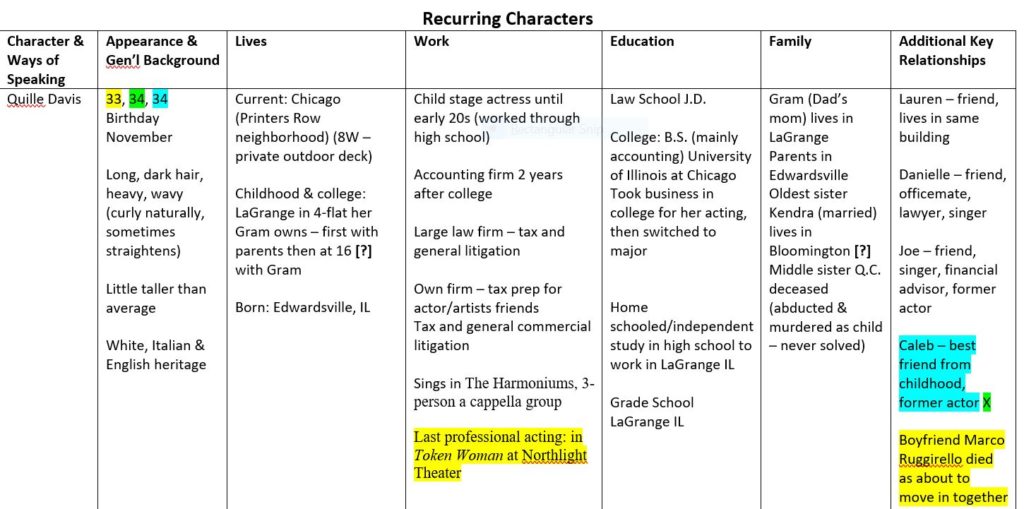
Here’s part of mine for Quille C. Davis, the protagonist in my Q.C. Davis series:

Chart of Recurring Characters for Q.C. Davis Mystery/Suspense Series

One tip I picked up from Author Lorna Faith in her article on the topic is to split out lists of characters. For example, you could have one for main characters and one for secondary characters.

I’ve started splitting mine by recurring characters, characters that appear in each specific book only, and characters that the short stories features. (I write short stories that fit between the novels to explore side character and side plots. Those stories are available to newsletter subscribers as a bonus.)

Setting Subcategories

Settings also may include sub-categories and may need to be quite extensive depending on what type of book you’re writing. Here are a few:

  • Settings for specific scenes (such as a coffee shop, your character’s home, a cave)
  • Locations (such as a particular city, country, planet)
  • Timeframe (especially key with historical fiction)
  • World-building  (special powers and other special rules of the world, history, culture)

At first I thought I’d just remember settings because my Q.C. Davis series is set for the most part in present-day Chicago where I live.

But now that I am on my third novel and am about to write the third short story, I’ve discovered details aren’t so easy to recall.

Does Quille’s favorite cafe have a fireplace? Is her friend Joe’s condo in Chicago’s West Loop or River North neighborhood? Did I talk about how Chicago streets are laid out on a grid before?

Style And Consistency

Tracking your styles to ensure you are consistent can help both your writing and your marketing.

Style includes how you name, format, and spell certain key things. Within your stories, you’ll want to be consistent in things like whether you italicize names of books or movies characters mention. Also, how you spell a character’s name. (I kept forgetting if a character names Carole Ports uses the “e” at the end or not.)

Style matters for marketing, too.

As I’m setting up the preorder for The Fractured Man, Book 3 in my series, I realized Book 1 on Kobo had the series name as “Q.C. Davis” and Book 2 as “Q.C. Davis Mystery”.  On another platform one of the books was missing a sub-title.

Nothing like making it harder for your readers to find the books!

Creating And Formatting Your Bible

I’m using tables in Word to save my information, but there are lots of options.

You might prefer other programs like Srivener, which has many options for creating bulletin boards and categories, or spreadsheets on a program like Excel. You could also hand write pages and put them in a binder, use index cards, or create a chart on posterboard on your wall.

The key is what will make it easiest for you to find the information you want quickly.

I suspect I’ll eventually print the separate Word tables and put them into a tabbed binder. The Word doc will be good for searching for particular terms. The paper binder will be good for paging through for ideas or reminders.

One last tip: Color coding by book or story is a great way to remember when you introduced a particular character, setting, or fact.

That’s all for today. Until next Friday, when I’ll talk about when (and when not) to use adverbs

L.M. Lilly

P.S. If you’re struggling with fleshing our your characters, you might find my book Creating Characters From The Inside Out helpful. It comes in workbook and ebook editions.

Creating A Healthier Home Office

The more time I spend writing and working in my home office, the more my physical surroundings affect my body and well-being. This article shares some things that help me feel better and lessen aches and pains as I write.

First, a quick caveat:

I’m not an occupational therapist or other health professional. Below are products that help me, but you should do your own research, and consult with a professional if you need to, to figure out what works best for you.

Also, as an Amazon Associate I earn from qualifying purchases made through this site, but that doesn’t add any cost to you. And I don’t recommend anything I don’t personally like or find useful.

An Adjustable Chair

A few months ago I started having a lot of lower back pain.

That was partly due to an injury, but as I worked through it in physical therapy and my back improved, I started noticing that I had the most problems after I wrote for long stretches.

That really shouldn’t have been a surprise, because I was using an old wood dining chair at my desk instead of an office chair. The dining chair wasn’t tall enough for my keyboard. (Generally, articles I’ve read on ergonomics state that your hands should be roughly even with your elbows when you’re typing.) It also was completely stationary, so when I moved it didn’t move with me. Instead, I was twisting my back.

After a lot of research, I settled on this black mesh office chair from The Container Store for $199.

I found it a bit challenging to put together but not too bad. No special tools needed.

One thing I really liked about assembling it myself is that I was able to leave the arms off of it. I like to be able to sit close to my desk and chair arms usually get in the way.

The height is adjustable using a lever at the chair’s base. That’s the most important feature for me. There’s also a feature for tilting the chair forward and back.

The one drawback is that the back of the chair is not quite right for my lower back, which is why I use a pillow with it. My low back pain, however, has almost completely disappeared since using the chair, so I think it was a good choice for me.

I recommend trying out any chair before you buy it. Though I ordered this one from The Container Store online, I sat in it several times in the store near me first.

A Separate Monitor

The other thing I was doing that was not at all good for my neck was typing on my laptop without a separate monitor.

That meant I was looking down all the time.

I realized that my neck was bothering me more than it had when I was practicing law full time. The major difference was that at my law office, I had a separate monitor and in my home office I didn’t.

The height of the HP monitor I bought for about $120 (with tax) is easily adjustable by placing my hands on either side of the monitor and sliding it up and down. This makes a big difference because I easily set it so that what I’m writing or viewing is at eye level.

I don’t need to look up or down.

Because the screen is wider than my laptop’s, the print is large enough that I don’t tend to push my head forward to read.

The sound of the monitor is a bit tinny, something that a couple reviews of it warned me about. That doesn’t matter to me, though, because the sound quality of my laptop is good, so I just use that. Also I bought the monitor for word processing, using spreadsheets, and working online, not for gaming or anything else that requires excellent sound or graphics.

In my view, buying the monitor saved me money because I need fewer massages and fewer chiropractic visits to stay out of pain.

A Foam Roller In Your Home Office

Foam RollerI discovered foam rollers when I was in physical therapy years ago for my neck stiffness and pain. It felt so good to lie on the roller the long way with my arms out and to do other exercises with it that I bought one of my own.
I got mine at Athletico Physical Therapy. I take breaks every 35 minutes or so when I write, and I use the foam roller once or twice a day during a break to stretch.

Here’s a video showing some of the stretches I do. I do the first and the third shown on the foam roller. (Again, remember, this is not medical advice.)

You can also find foam rollers on Amazon or other websites.

Separate Keyboard And Mouse

Many people also find it helpful to have a separate keyboard from their laptops or an ergonomic keyboard for whatever computer they are using.

This is my Microsoft Natural Keyboard:

Microsoft Natural Keyboard

When I type on it, my elbows are out away from my sides. My hands also are angled rather than being straight out in front of me. I’ve read that this position is far more natural for our bodies.

It takes a bit of practice to get used to where the keys are and how to hold your arms. Once I did, though, I found this keyboard so much more comfortable than a regular one.

I also use a Kensington ergonomic mouse with a track ball. Sometimes I switch it from one side to the other to vary my hand position.

These are just a few ideas you can try to improve your home office set up. The key is experimenting and paying attention to how your body feels.

That’s all for today. Until next Friday when I’ll talk about creating a Series Bible —

L.M. Lilly

How Free Time Increases Productivity

As my many productivity articles suggest, I lean towards scheduling my work tasks in advance. It helps me focus and cut down on the time I spend each day trying to decide what to do next.

But free time matters too.

In fact, planning unscheduled time in each day (another tip I picked up from the book Extreme Productivity: Boost Your Results, Reduce Your Hours) can help you get more done and feel less stressed.

How does scheduling free time help you get more done? In three ways:

  • It makes room for unexpected tasks
  • You can pursue ideas that excite you in the moment
  • It opens time to consider the big picture

Free Time For The Unexpected

One reason to reserve free time in your work day or writing schedule is that things always come up that you didn’t expect.

It might be something you wish you didn’t need to do but that’s vital.

Maybe your boss throws a new project at you. Or a longtime customer calls with a complaint. Perhaps you discover an article is due a week earlier than you thought or you miscalculated how much time you’d need to finish a manuscript before sending it to an editor.

We tend to treat these types of things as aberrations. But unexpected issues and tasks pop up at least once a week if not once a day.

If you don’t have open time in which to do them, you’ll need to spend even more time rearranging your other work. And/or you’ll find yourself working late or on weekends too often. (Something that I did a lot in my law practice. (I really wish I’d found Extreme Productivity back then. It explains so many of the issues I had.)

Planning time to deal with the unexpected makes work and writing much less stressful.

What Excites You Right Now

On a happier note, scheduling dedicated free time (I know, that’s an oxymoron but you know what I mean) also allows you to follow up on that thing that catches your attention and excites you.

Generally I’m a fan of putting my head down and doing the work, whatever that work is.

It’s how I’ve finished multiple novels. I don’t wait until I feel like writing, and I don’t stop writing if I feel a little frustrated or tired.

But spending your entire work life that way is wearing. And it’s unrealistic to expect ourselves to never go off on a tangent. That’s part of what keeps life interesting and fun.

For example, a new story idea hits you that you’re superexcited about right now. If you’ve got just 15 minutes set aside  in your day as free time, you can jot down your thoughts or write a few paragraphs.

Odds are that after you do you’ll feel refreshed and more able to focus on your other work.

The Big Picture

Open time each day also ensures that you have time to think beyond just getting your day-to-day work done.

As an Amazon Associate I earn from qualifying purchases made through this site, but that doesn’t add any cost to the buyer.

When I was running my law practice I typically scheduled every hour, cramming in as much as I possibly could. In the long run, I spent so much time grinding through each day that I never stepped back to ask myself if this was the type of practice (and life) I’d hope to create when I went out on my own.

As a result, while I liked running my own firm, after several years I discovered I had many of the same problems. Too much work and stress. Too little time to relax or write. Not enough of the types of legal work I enjoyed most.

I’ve heard from many authors who get into a similar position.

In their push to turn out multiple books so that they can earn a living, they lose track of the love of writing that drew them to the profession in the first place.

There’s nothing wrong with working hard to get to where you want to be. But reserving some free time allows you to consider where you are, how you feel about your work and your life, and what you might do differently for greater happiness.

That’s all for today. Until next Friday, when I’ll talk about setting up a healthier home office —

L. M. Lilly

How Character Influences Dialogue

A character’s character (so to speak) influences dialogue — both its content and the way the character talks. Below I compare the same two books from last week’s article Dialogue, Pace, and Genre, The Seven Sisters and Phantom Prey.

We’ll look at:

  • Time Period
  • Key Conflicts
  • Chatty Dialogue
  • Character’s Career Or Position

Time Period, Character, And Dialogue

When a character lives influences who that person is. It also affects how that character speaks, as does the type of book.

The Seven Sisters (published in 2015) is a family drama that takes place in two different time periods: present day and the 1920s. Compared to the 1920s characters (Bel and Laurent) the present-day characters (Maia and Floriano):

  • use more contractions
  • speak in shorter sentences
  • use more casual language such as “thanks” rather than “thank you” and “okay” rather than “yes”

The crime novel Phantom Prey (published in 2008) takes place in present day.

Compared to all four characters in The Seven Sisters, in Phantom Prey characters Lucas and Weather:

  • use more contractions
  • speak in much shorter sentences on average
  • use casual phrasing more often
  • swear

The Characters’ Main Conflict

The content of dialogue also changes based on the key conflict for each character.

For instance, in The Seven Sisters, the present-day plot revolves around Maia, who was adopted, finding her birth family. Bel, the protagonist of the 1920s story, faces an arranged marriage and a restricted life. She longs to be a freer spirit. The two stories connect through a sculpture significant to both their families.

In keeping with these conflicts, on pages 87-92 the present-day characters Maia and Floriano talk about:

  • the famous sculpture
  • Maia’s quest to find her birth relatives
  • the history of the part of Brazil where Maia was adopted

Bel and Laurent (1920s) on pages 194-197 talk about:

  • Laurent’s life as an artist who assists a sculptor in Paris
  • Bel’s unhappiness with her family and life in Brazil
  • Bel’s arranged marriage
  • The freer life Bel could have in Paris weighed against her obligations to her family

Phantom Prey is a crime and suspense novel. On pages 25-29, protagonist Lucas and his wife, Weather, talk about:

  • Weather’s friend, whose daughter is missing, and Weather’s hopes Lucas will look into the crime
  • Blood found in the friend’s house
  • Details of a separate murder
  • A police investigation

Chatty Or Not?

The nature of the novel’s main conflict also affects how often the book includes what I think of as chatty dialogue. Chatty dialogue sets the stage or shows daily interactions among the characters but doesn’t move the plot.

Throughout The Seven Sisters characters say good morning and hello, ask how one another are, and talk about what they’ll have for breakfast. This type of dialogue reflects that the novels’s conflicts are primarily about relationships among the characters.

For example, on page 84, these lines of dialogue appear when Maia answers the phone:

“Hello?”

“Señorita D’Apeliese?”

“Yes.”

“It’s Floriano here. Where are you?”

“In a taxi on my way to see the Cristo. I’m just near the train station now.”

“May I join you?”

In contrast, Phantom Prey rarely includes any dialogue of the “hello, how are you” variety.

In fact, the first line between Weather and Lucas is “I saw Alyssa today.” Alyssa is the woman whose daughter disappeared and in whose home blood was found.

While Lucas and Weather, who are husband and wife, also joke around about eating cinnamon rolls and about sex, that happens toward the end of the conversation and is part of a push and pull between them over whether Lucas will investigate the crime or not.

The Characters’ Profession Or Position In Life

The position of characters in society and/or their jobs or careers also affect what they talk about.

For example, Lucas is an investigator and former police detective. Weather is surgeon.

When they discuss a murder, they talk about the force that was used, the organs damaged, the amount of blood, and other specific details. If Weather were a stay-at-home mom or an accountant, she and Lucas probably wouldn’t have such graphic discussions.

Bel’s focus on her marriage and the limits of her life arise from her position as the daughter of a wealthy man who seeks standing in society. Her marriage can help achieve that for her family.

Earning her own living in 1920s Brazil isn’t much of an option for her. While Floriano suggests that she could become a model in Paris, such a profession is far outside of what her family would ever be comfortable with her doing. As a result, she and Floriano don’t spend a lot of time talking over what skills Bel might develop or any other type of work she could pursue.

I hope this analysis helps as you write your own dialogue.

L.M. Lilly

P.S. If you’re working on a novel and could use some help sorting out the plot, check out my free Story Structure Worksheets here.