Believable Characters And Plot Turns Through Foreshadowing

While the main goal of foreshadowing is to keep readers turning pages, when you foreshadow you also make later plot turns and character choices believable.

Doing so makes a promise to the reader that’s important to honor.

Believing What Happens Later

If you foreshadow a character’s future action or a plot twist, that helps keep readers immersed in your story. Otherwise they they may pause and question what to you seems like a natural story development.

As an example, in Pride and Prejudice Elizabeth Bennet engages in a friendly debate about Bingley, the man her sister loves.

WARNING: spoilers below. But you’ve read Pride and Prejudice already, haven’t you? No? What are you waiting for?

Bingley’s friend Darcy criticizes Bingley for what he calls an “indirect boast.” (Nowadays some might call it a humble brag). Bingley admits to thinking and writing so rapidly he sometimes conveys nothing to the reader and to being likely to act on the spur of the moment.

As the three debate whether those qualities are pluses or minuses, Darcy points out that Bingley might easily change plans if asked by a friend to do so.

Darcy sees that as a fault, but Elizabeth points out that regard for one’s friend can be admirable and might often persuade a person to do something without waiting for a specific reason.

The scene contains its own conflict due to Darcy’s and Elizabeth’s unacknowledged feelings for each other. Also, Elizabeth wishes to forward her sister’s and Bingley’s romance. Bingley’s sisters and Darcy oppose it.

So the scene stands alone fairly well, and the dialogue is great fun to read.

But the exchange also lays the groundwork for later conflict. Bingley, acting on the spur of the moment and under the influence of Darcy, leaves town and does not return, breaking the heart of Elizabeth’s sister Jane.

Without this earlier exchange about Bingley’s character and his willingness to act on a friend’s request, readers would be far less likely to believe that he’d abandon Jane. Darcy’s role in the Bingley/Jane drama and Elizabeth’s reaction to it drive much of the novel.

Because of that, it’s key that readers believe Bingley would take off at a moment’s notice without giving a lot of thought to what might happen down the road.

He Did What?

The debate between Darcy and Elizabeth also gives us, ahead of time, reasons for Bingley’s actions that make them more understandable.

Without that foreshadowing readers might not want Bingley and Jane to get together again. He’d seem like he purposely misled Jane or that his affections were less strong than hers and too easily changeable.

Also, Elizabeth saying early on–and when it doesn’t affect her sister–that  willingness to defer to friend’s wishes can be a positive trait means she’s all the more willing to lay Bingley’s actions at Darcy’s door. And it makes clear that Darcy understands how much influence he has on his friend.

Readers are more apt to believe the feelings and actions of all three characters because of what at first seemed like mere drawing room conversation to pass the time.

Promises Promises

You’ve probably heard the old saying that if there’s a gun on the table in Act 1, it  needs to be used by the end of the play.

Readers consciously expect a gun (or a bomb under the table) to matter if it’s shown to them. They’ll wonder about it throughout the book and feel let down if in the end it doesn’t matter.

That type of foreshadowing also makes a promise about what type of story to expect. The gun suggests violence, suspense, perhaps a thriller or mystery. If you instead hand readers a romantic comedy, they’ll feel cheated and angry that they spent their time reading your book.

Similarly, if you start your novel with a meet cute and one of the characters is murdered halfway through, most readers will put down the book and never return.

This guideline applies in a more subtle way when you foreshadow the way Austen did with the Elizabeth/Darcy debate.

As I mentioned, the dialogue is fun to read all on its own. Also, there’s probably enough conflict that readers wouldn’t wonder why it was there even if it had nothing to do with later events.

The entire novel, however, contains many such exchanges that foreshadow later events. If none of them led to anything significant, half of Pride and Prejudice would simply be witty banter. It’s doubtful people would still be reading and writing about the classic novel today if that were so.

Because all those conversations also hint at what’s to come, though, each time I read the book I see something new and engaging in it. Each time I’m more impressed by how Austen wove her plot together and I’m more engaged by the characters.

That’s all for now. Until next Friday, when we’ll talk about one way to make your novel a fast read

L.M. Lilly


Keep Readers Turning Pages With Foreshadowing

Foreshadowing is a great way to keep readers turning pages.

The main goal of foreshadowing is to create suspense. That suspense keeps the reader turning pages to find out what happens.

It’s often done early in a novel or story, including in the first line.

The end of a chapter is another good place for foreshadowing because the chapter ending is a natural place to stop reading. How many times have you said, “I’ll just read one more chapter” before going to bed? A story question or hint urges the reader to continue on.

There are many ways to foreshadow, including directly, by hinting, and by setting a tone.

Direct Foreshadowing

You can tell the reader directly what’s to come.

In a novel called The Streets Beneath, which I never published, I started with what remain my favorite first lines:

I didn’t mean to follow the judge. And I definitely didn’t know he would end up dead.

Those lines directly state the main story question, which is who killed the judge and why. They incorporate two crucial characters–the narrator and the judge. The first chapter of Streets got many editors and agents to ask for the entire manuscript, and I suspect it was due to these lines.

(This was back in the day when getting a traditional publishing contract was the only way to publish a book. Unfortunately, I don’t think the rest of the manuscript delivered well enough on the promise, which is why I haven’t published it myself.)

The Hint

You also can hint at what’s to come. The first line of Pride and Prejudice does that by giving a sort of proverb:

It is a truth universally acknowledged, that a single man in possession of a good fortune, must be in want of a wife.

This line doesn’t directly include any specific character or outline the exact conflict.

But the stories of our main character, Lizzy Bennet, and her sisters all revolve around marriage. More specifically, because the family’s estate passes only to male heirs, all the sisters will be homeless and nearly penniless when their father dies. It’s therefore key that one or more of the sisters marry someone who can provide for them.

The fortunes, or lack of fortune, of the men they fall in love with, or who seek to marry them, are key to all the conflicts in the book, as are the neighbors’ views about the sisters.

All these things are hinted at by that single first line.

Set A Tone

Foreshadowing can be used to set a tone that draws the reader in.

You see this approach with the “dark and stormy night” type of first line. When a novel starts or a chapter ends with a thunderstorm on a chilly night, odds are we’re not in for a light, happy read.

Weather is not the only way to set a tone. Gillian Flynn’s Dark Places starts with:

There is a meanness inside me, real as an organ. Slit me at my belly and it might slide out, meaty and dark, drop on the floor so you could stomp on it.

Even if you hadn’t heard the title and didn’t know Gillian Flynn is the author of dark thriller Gone Girl, you’d have a pretty good idea what type of book you’re reading.

That’s all for now.

Until next Friday, when I’ll talk about the role of foreshadowing in building credibility and character and the importance of  keeping promises to your readers—

L.M. Lilly

Using Your Writing Skills To Become Happier

I often feel that the same imagination that helps me plot and write novels works against me in real life.

The What If questions writers use to create significant conflict in fiction can also prompt us to scan our personal lives for danger. And our need to escalate conflict in our stories can bleed into envisioning worst case scenarios for ourselves.

Thinking that way can become a habit that makes it hard to enjoy life.

Looking For Happiness

To counteract that, over the years I’ve made an effort to use my writing to enhance happiness, not fear.

One wonderful way to do that is to focus on what we’re grateful for.

Starting Small

If you’re in the middle of a truly difficult time feeling grateful can be hard. But you can start small.

For example, you’re reading this article, so right there is something to be grateful for. Not everyone can. According to the Chicago Literacy Alliance, 30% of adults in Chicago, where I live, have only low basic literacy skills, and 61% of low-income households in Chicago own no children’s books.

So right now you can take a moment to feel grateful for being able to read.

And there’s more good news. Gratitude gets easier with practice. The more you look for and note, ideally in writing, things that you’re grateful for the more of them you’ll start to notice.

Vivid Writing And Gratitude

Writing about what we feel grateful for fixes it more firmly in our minds.

It also creates a record of the good things in our lives to look back on when we need it. And, as with any other kind of writing, the more detail, the more real it seems and the more fixed it becomes in our hearts and minds.

For instance, if you’re grateful because your cousin, whom you don’t see often, came into town and you had a nice dinner don’t just write Dinner with my cousin.

Instead, use your memory and writing skills to expand on the parts of the evening. Make them vivid by using all your senses:

  • Lasagna came out just right—the fresh garlic and fresh tomatoes made it taste fantastic
  • Shared stories about our parents—heard ones I never knew about my mom which helped me understand some things she said to me when I was growing up
  • So enjoyed the gourmet root beer – reminds me of summer vacation as a kid and going to A&W as a treat
  • The warmth of the fireplace and the sparkling white holiday lights looked beautiful and made me feel cheerful and relaxed
  • Fresh-baked chocolate chip cookies for dessert made the whole apartment smell great and feel warm and cozy; loved the dark chocolate for the chips

Even if you’re also right now worried about whether you’ll find a new job, or whether your books are selling, or how you’ll finish your novel in the few spare hours you have, it’d be hard not to feel good while writing a description like that.

What are you grateful for?

Take ten or fifteen minutes and write it down. I bet you’ll feel wonderful.

Until next Friday–

L.M. Lilly


4 Reasons To Stop Saying You Don’t Have Time

We’ve all said it, probably several times in the last week or two — “I don’t have time.”

Most of us, especially if we’re juggling writing and another career, a job, or family responsibilities, feel like we don’t have enough time to do all the things we want to do.

In one way, that’s true. It’s not like we can manufacture more hours in the day.

In another way, though, it’s not accurate, as I’ll talk about in the first of four reasons to stop saying I don’t have time.

Reason 1: It’s True But It’s Not

When we say we don’t have time to do a particular thing, that’s only true in the sense that we can’t fit in everything we’d like.

But it’s also not true. Because at that moment we are doing something, even if it’s sleeping. We could choose to do something else.

As an example, imagine you’re working on a report for your boss that’s due in an hour. Your mom calls. She just wants to say hello. Even if you and your mom have a good relationship, you’ll probably say, “I don’t have time to talk.”

Now imagine instead your sister calls. She says your mom had a terrible accident. She needs a blood transplant, and you are her blood type.

Do you tell her you don’t have time to help?

No. You tell your boss you need more time for the report and leave to go to the hospital.

You literally have the same amount of time in both scenarios. Your report is due in an hour in both. Yet you make a different decision.

I can hear you telling me to hold on.

In the first example, your boss will be very unhappy with you and might fire you while in the second, assuming your boss is a reasonable person, there will likely be no negative consequences. Or you’ll deal with getting fired if you must, as your mom’s life matters more.

But the difference is consequences and what matters most to you, not time.

In the first scenario, it’s accurate to say, “I have a report due in an hour, so now isn’t the best time for me to talk.” Not “I don’t have time.”

This change may not matter to the person to whom you say it. That person understands what you mean.

But, as we’ll talk about below, it does matter to how you feel and the choices you make.

Reason 2: It Makes You Feel Out Of Control

If you say “I don’t have time” and believe it, it leaves you feeling like you have no control over your life. Sometimes it’s as if we’re careening from one crisis or responsibility to the next with no say in how we spend our time.

I felt that way often when I was practicing law full time at a large law firm and writing on the side. That feeling intensified when my dad was in the hospital. Every waking minute was spoken for. And when I looked ahead, I didn’t see any light at the end of the tunnel.

On the one hand, the busy law practice was great. It meant I had lots of cases and clients and no trouble paying my bills. I also had job security. Loads of it, despite a recession on the horizon.

But it also meant I had very little time to write, relax, or be with family or friends, and I felt as if I never would. That made me sad and angry, on top of how I already felt about my dad’s injuries, which were life-threatening.

Because I framed the issue as not having time, though, I felt there was nothing I could do. I couldn’t manufacture more time. Everything felt completely out of my control.

That’s not a place anyone wants to be. The good news is that changing how we identify the problem can help us gain control.

Reasons 3: Values Matter More Than Time

As the examples about your mom show, what we value governs our lives and how we spend our time. When we choose words that reflect that, we can decide what to do based on those values rather than feeling helpless.

That one change may not give us every option we’d like, but it gives us more than when we blamed time.

As to the work situation I described, I became more honest with myself. I’d chosen to work where I did knowing the schedule that was expected. I wanted to quickly gain experience as an attorney. I also wanted to earn the salary I did.

For the first five years or so that trade off seemed worth it. That was especially so because I’d had times when I couldn’t work and couldn’t pay my bills due to a repetitive stress injury.

But now I more highly valued time to write, time to spend with my friends and family, and time to relax. My job wasn’t compatible with those values.

I’d been blaming lack of time for my unhappiness. The reality was, the structure of the firm where I worked depended on attorneys working excessive hours. Also, my practice area didn’t allow for a regular schedule. Though I did have some free hours, I never knew for certain when they would be.

That type of work situation simply no longer fit with what I wanted from life.

Once I understood that, I could deal with it.

Reason 4: It Keeps You From Changing

So how does refraining from saying “I don’t have time” and focusing on values change anything?

Even if your situation can’t immediately be changed, identifying and talking about it accurately allows you to think long-term and figure out what to do.

For me, talking about values rather than time wouldn’t make my dad recover or heal. In the short term it wouldn’t change my schedule. (Unless I wanted to quit my job on a moment’s notice, and I didn’t. I still valued paying my bills!)

But in the long term, accurately identifying the issue as a values conflict gave me back choice and control. I devoted an hour or two each month over the next year to figuring out what I could do for work instead. Eventually I did change my work situation by starting my own law practice. A few years later, I published my first novel.

(Unfortunately, to a large extent I recreated much of what I’d left and had to relearn some lessons the hard way, but that’s another story.)

For a different example, let’s say you’ve got small children and are working a part-time job. You feel there’s not enough time to write the novel you’d love to write.

First, you’d look at your values.

Cramming writing a novel into your schedule might add too much stress to your already stressful life. For your mental and emotional health, you might need to value peace of mind more than writing. Or you might feel strongly that writing a novel would take too much time away from your children, and you’re not willing to do that.

If either or both are true, you might decide you won’t devote significant time to writing until three years from now when your kids start school.

Having decided that, you can stop blaming time and feeling out of control. And you can start looking for ways to satisfy your desire to write.

That might mean writing a poem here and there. Or starting a journal. Or you could carve out fifteen minutes whenever possible to plan that novel so that once the kids are in school, you’ll hit the ground running. (For ideas on that, see Writing A Novel 15 Minutes At A Time.)

None of that gets your novel written this year. But you’ll feel better because you’re moving toward your goal and acting in a way that’s consistent with what you value most.

Also, you’ll stop feeling like you have no control, so you’ll be calmer and happier. Which might make it easier to free up those fifteen minutes here and there.

That’s all for today. Until next Friday when I’ll talk about Using Your Writing Skills To Become Happier

L.M. Lilly

When To Call Your Novel Finished

As I move into the last stages of writing my latest novel, I’ve been thinking a lot about what it takes for me to call a manuscript finished.

I don’t think I’ll ever be an author who releases a novel a month as some indie authors do. At the same time, I don’t want to release only a book a year.

The book-a-year schedule leaves a long time for readers to forget about my characters and their stories and makes marketing harder. It’s also frustrating creatively because it feels like I’m working hard but not getting a lot done.

So I’ve been transitioning.

In my first series, it was two and half years between the first couple books, then a year. With my new series, I’m aiming to release two novels a year.

The Deck Chair Method

In the days of traditional publishing, I’d rewrite multiple times before querying agents or editors. And I’d rewrite again if any of them asked me to rewrite and resubmit or sent personal comments or suggestions that resonated with me.

That was a good learning experience.

But looking back, I spent far too much time simply rearranging or making minor changes. Basically, to use a cliche (I know, I know, I’m a writer, I ought to be more original) I didn’t feel finished until I was doing the equivalent of rearranging deck chairs on the Titanic.

My other way of knowing I was done was if I felt like I’d throw up if I had to look at the manuscript again.

Finishing Faster

Instead, in the last book and my current one I’ve been trying to look at the separate parts of the manuscript to see if it’s working well. If it is, I make myself stop fiddling with it.

I look at what each scene is doing or not doing, the characters, the dialogue, and the line editing.

Scene By Scene

To call a novel finished, each scene needs to move the plot and/or develop a character.

Because I write suspense and thrillers, I try very hard to have no scenes, though, that are only character development. A literary novel can do much more of that, but most readers of commercial fiction–which is largely what I love to read and write–want the plot to move quickly.

Any scene that doesn’t move the plot, I cut.

Caveat: All my books have an element of mystery. Because of that, some scenes are moving the plot but that’s not obvious on first reading. For instance, a small detail about a character may be revealed that seems insignificant but that later provides a key to what’s really happening.

I try to work those revelations into another scene that also clearly moves the story, though, so as not to lose reader attention.

Characters: 3D Or Not 3D

In my first outline of a novel, and in my zero draft, some characters are there simply to serve a plot purpose.

When I wrote the first draft of The Worried Man, for example, a couple of the alternate suspects simply walked on, said their lines, and walked off and I knew next to nothing about them.

When I rewrote, I picked out the characters that needed to be fleshed out. I developed back stories for them, some of which I worked into the novel, some of which remained only in my mind.

Some of those characters ended in being reader favorites.

To call a novel finished, I need to feel I know each character well and that each is distinct.

Caveat: How much character development is enough varies by genre.

Book 1 in The Awakening Series

The Awakening, Book 1, a supernatural thriller, on one day got back-to-back reviews with opposing views. One praised the characters as being so well-developed, the other said the characters were all flat.

When I looked at other books the reviewers read, the first one read a lot of thrillers and suspense and the second read more general fiction and literary. Because the first fell into my target reader category, I felt the characterization was sufficient, but I did in later books further develop two side characters the critical reviewer mentioned.

Dialogue

In a final draft, the dialogue should sound real but not actually be realistic. To achieve that, I do my best to cut lines that people say in real life but that don’t move the story or reveal character. (Such as: “Hey, how are you?” “I’m fine, how are you?”)

Also, ideally, each character’s voice is distinctive.

One of the side characters in my current novel is very dramatic. Her bus ride in bad weather is “horrible” not “annoying.” Another woman’s shoes are “stunning” not “pretty” or “cute.” Another character has a verbal tic where she describes people as “little” regardless of their actual size.

Other differences are more subtle. My protagonist’s best friend tends toward light sarcasm. My protagonist has a wry sense of humor. When I’m close to finishing, I look for those types of distinctions and revise the dialogue to try to make it fit each person.

Caveat: I do my best to make most characters’ voices unique, and in a perfect book, you’d know who was talking without any dialogue tags.

But doing that for every single character could both take forever and would probably read like a spoof on bad writing. In real life, not everyone has a quirky way of speaking or sounds that different from someone else with a similar background or experiences. You need to decide how much time and effort and how far you want to go to differentiate dialogue.

In my favorite book of all time, Pride and Prejudice, some characters are completely recognizable in how they speak. For others, it’s sometimes difficult to tell one from another. Yet the book remains popular hundreds of years later.

Line By Line

Line editing is also key to finishing a novel. I used to do it only at the end. Now I try to line edit as I go if I can do it quickly, and then do a pass again later.

For me, this process involves:

  • Ensuring sentence length varies
  • Splitting most sentences over 3 or 4 lines into two sentences
  • Varying paragraph length
  • Not starting more than two sentences in a row with the same word
  • Checking for typos and grammar errors
  • Avoiding passive voice unless there’s a reason for it (such as that’s how that character talks or I’m trying to deemphasize the subject of the sentence)

Caveat: Good line editing is vital. But it can be a little too easy to spend endless hours line editing if you like to do it, as I do.

Many books with a strong plot do well despite clunky writing. (In my view, several James Patterson novels fall into this category and no one can argue with his success.) I don’t aspire to clunky writing. Yet sometimes I need to stop because the changes I’m making may, to me, improve the writing but will make little or no difference to the reader.

That’s all for today. Until next Friday, when I’ll talk about 6 Reasons To Create An Author Video

L.M. Lilly

P.S. If you’re looking to improve your characterization, you might find my Free Character Creation Worksheets helpful.

More Ways To Rewrite Your Novel

I’ve always been more of a rewriter than a writer.

In a lot of ways, that’s a good thing. I write first drafts very fast because I know I can fill in gaps or fix whatever’s not working in rewrites. For the same reason, I rarely get stuck. If you’re not sweating over the perfect word, line, or plot twist, it’s a lot easier to get words on the page.

But it also means I spend a lot more time at the keyboard.

So lately I tried a new way to revise. Comparing it to my previous techniques, it gets me away from the keyboard more and helps me work faster.

First Drafts Are Different

When I first draft, I use dictation software or dictate into my iPhone. I love dictating for several reasons:

  • It helps me write faster
  • It makes my tone more conversational
  • I’m more comfortable standing while dictating than while typing so I break up my many hours of sitting
  • My neck and shoulders ache (and eventually I have serious pain) when I type a lot

But I’ve never found a good way to dictate revisions.

Rewriting At The Keyboard

My first rewrite is typically at the keyboard. I read on screen and correct as I go. These changes include errors from the dictation as well as obvious plot issues, changes to character names, and other problems I noted as I wrote.

This rewrite usually goes very fast. I consider it part of the first draft process, as I don’t feel my initial draft is done until I’ve gone through it once on screen. (I talked about this more in Writing The Zero Draft Of Your Novel.)

After that I print, and here’s where I’ve started varying my process.

Looking At Manuscript Pages

After letting my complete first draft sit a week or two, I print it and read it. I note big picture issues separately and I handwrite in changes.

Over the years I’ve dealt with those handwritten changes two different ways. I’ve entered the changes myself, doing further revising as I go, and I’ve sent them to an off-site assistant.

The last time I sent the manuscript to an assistant it cost me $200 for half the manuscript. While she worked on first half, I entered the handwritten changes myself for the second half.

I’m not sure which way is more efficient timewise.

It was nice to be able to work on my half while she did the other, but I feel I lose something not making the edits myself.

And for both, I found it difficult physically. It amounted to a lot of time in front of the keyboard because for the assistant’s changes, I did a second pass through of my own as well on screen.

A Different Way

For what I hope is my last major rewrite of my current novel, The Charming Man (Book 2 in my Q.C. Davis series), I tried something different.

I printed all the pages and rather than mark them up by hand I read them on paper but typed the changes I wanted directly into the Word version.

Here’s what I liked about this process:

  • Reading on the page rather than on the screen altered my posture, leaving me with almost no neck or shoulder pain despite typing the edits
  • I saw errors on the page that I would have read right through on the screen
  • I saved time because I didn’t need to first handwrite changes and then enter them

What I didn’t like:

  • Nothing

The real test will be what I think of my novel after I set it aside again.

For now, though, I’m pretty sure this rewrite process is one I’ll continue using. It seems easier on my body and my budget (both in a time and money sense) and I feel pretty good about the changes I’m making.

That’s all for now.

Until next Friday, when I’ll talk about figuring out when your novel is finished

L.M. Lilly

P.S. Still working out the plot for your novel? The Free Story Structure Worksheets from Writing As A Second Career might help.

Writing And Missing Teamwork

The last few days I’ve been thinking about teamwork. As in, not having it.

These thoughts started a couple weeks ago as I finished my six-article series on things to figure out before you shift to writing full time. The feeling that I was overlooking an issue of my own kept nagging me.

Yet as I reviewed my articles it seemed like I’d covered everything major.

Fun With Podcasting

The feeling that I was missing something came to me most when I listened to podcasts. I felt envious.

For a while I thought it was because I wanted to start a podcast. I even had an idea for one.

Writing about women protagonists matters to me, and it bugs me that so many movies relegate women to little more than walk on roles. Also that women are usually shown in isolation from other women, interacting only with men.

But when I looked seriously at what was involved in producing a podcast, my enthusiasm waned. Already I have more on my plate than I want. I’m looking to scale back so I can focus on finishing novels and non-fiction books faster and spend more time figuring out what marketing and advertising is effective.

So I kept my idea but turned it into a blog series Women, Men, and Movies on my author website.

Doing that killed two birds with one stone. I enjoy what I’m writing about, and it gives me a built in, consistent topic every week for the author site.

Yet I still felt envious of the podcasters.

Too Much Time Alone?

I also thought it might be about spending too much time alone.

As I wrote about in 6 Things To Figure Out Before You Start Writing Full Time (Part 2 – Mental and Emotional Health), having enough contact with people impacts emotional well-being. But I feel like I’ve done all right with that.

I’m teaching two legal writing classes this semester, so I see students 2-3 times a week and have a faculty meeting every other week. I make a point to get together with friends often, and my brother just visited for a weekend.

Most days I’m pretty happy with my balance of hanging out with people versus quiet, peaceful solitude. So that didn’t seem to be the issue.

Working Together

As I listened to Jim and Bryan bounce ideas off one another on the Sell More Books Show, it finally came together. It’s not that I spend too much time alone, it’s that I miss working with people.

As a lawyer, while I wrote and researched alone, overall I worked as part of a larger team. We talked through arguments with each other. We called to analyze the ramifications of a new decision by an appellate court. We traded our written briefs back and forth and commented on them. We had strategy meetings.

Now, though, almost all my work is on my own.

No one else weighs in when I decide where to advertise a book or whether to rewrite my manuscript another time before sending it to a first reader. And there’s no one to go out for a drink or coffee with and talk about the day’s or week’s progress. (Or lack of it, which is when you need the wine.)

My friends will listen (more or less) if I talk about my writing or the business side of it, but those who aren’t writers don’t feel they understand what I’m doing well enough to comment.

And those who are writers can empathize but we don’t actually work together.

What To Do

It’s not that I couldn’t work with another writer.

Some authors cowrite books or articles. But that’s never appealed to me. I appreciate outside feedback from a seasoned editor or critic once at a certain point in the process, but I love writing my books and don’t want to share that task with anyone else.

And while I’d love to have someone to share the business decisions with, my writing income contributes something toward my bills, but it doesn’t support me yet. So there’s not enough for a partner or an employee.

But I’ve only just become aware that I miss teamwork, so I don’t expect to know what to do about it yet.

It might be getting my writing career in better order and more focused so I can add volunteer work or a board position where I’d work with others.

Or it might be finding a way to grow a writing-related business so that it eventually requires a team. Maybe six months from now I’ll know. Or a year.

If you write and miss teamwork, I’d love to hear your thoughts on it. Opinions, solutions, questions, concerns, what have you.

Until next time, when I’ll talk about rewriting your novel

L.M. Lilly

Writing The First Lines Of Your Novel

Readers often decide whether or not to buy your novel based on its first lines.

No pressure, right?

As a writer, it feels unfair for so much to ride on a very small number of words. But your own book buying probably follows the pattern. If you like the cover and the description on the sales page (or the back of the book or inside book jacket in a book store), you open page one and read a line or two.

If you like it you may keep reading and buy. Otherwise, you’ll click away or walk away.

Fortunately, there are some things you can do to improve the odds that your first page will draw the reader in.

Rewriting Your First Lines

It sounds contrary to what I just said, but try not to worry about the first lines in your first draft.

Throw something on the page, get your first draft finished (and perhaps a second draft, too, depending how many rewrites you generally do), then look at whether your first lines do what they need to do.

The main reasons for that are:

  • Struggling to write perfect first lines in an initial draft can keep you from getting the book finished
  • Even if you plot or outline beforehand, what you want to convey in those first lines may change as you finish the book
  • You will get to know your characters better as you write and will have a better sense what tone to use

After all, if you never complete the novel, you’ll never need to worry about drawing readers in. So first things first, and in this case that means finishing the book.

Conflict Not Info

It’s tempting to include a lot of information in your first page.

You may feel your readers need it to understand the scene or story. But when you share a lot of background—known as an info dump—it can easily bore readers.

For one thing, they don’t yet know why that background information matters, so they have no compelling reason to keep reading it. Also, while a few readers may simply be interested in the subject matter, they picked up a novel for story. If they primarily wanted to learn about a topic, they’d likely grab a non-fiction book or watch a documentary.

So focus on story, which means focus on conflict.

You can hint at the major conflict of your novel or start with a more minor clash. Either way, though, someone on your first page must want something that’s hard to get or be confronted with a problem that’s hard to solve.

And if your reader needs information to understand what’s happening, look for a way to weave it into the conflict.

I did my best to do that in the first lines of the first book in my Awakening series:

Tara folded and unfolded the pink referral slip. Her fingers made sweat marks on the paper. “I can’t be pregnant. I haven’t had sex.”

These four lines introduce the main conflict for the entire book.

They show the main character’s nervousness–she’s folding and unfolding paper and her fingers are sweating. And they hint she’s in a doctor’s office, as she’s got a referral slip.

Had I started instead with a paragraph about Tara’s many younger siblings, or her plans for med school, or her boyfriend, I likely would have lost a lot of readers. They wouldn’t know what the story was about or if there was a story at all rather than a character study of an upbeat young college student.

See Some Plays

The best rule I ever heard for how much backstory or information to give the reader is to share whatever the reader needs to understand at that very moment.

Reading or watching plays is a great way to see that done.

That’s because playwrights don’t have the luxury of including a paragraph of exposition in a first scene or any scene. While a few plays have narrators who tell the audience information, that tends to bore audiences or take them out of the story, so typically everything must come through in character action or dialogue.

Pay particular attention to the first scene.

Think about how long it took you to understand what’s happening and whether the questions you had made you want to keep watching or left you frustrated and confused.

First Line Looks Matter

The appearance of your first page and first lines affects how likely a reader is to keep reading.

Dense text, long paragraphs, and long sentences put many readers off, particularly if you’re writing in a genre that’s known for quick reads or that’s meant to be light and fun.

Take a look at books you think are similar to yours.

How many sentences are in most of the paragraphs on the first page? How long are the sentences? Does the first page include only one or two paragraphs? Or five or six?

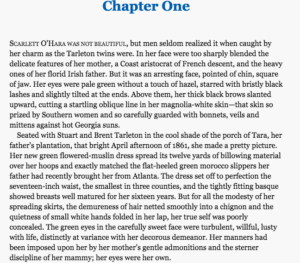
Also, keep in mind that readers’ preferences have changed over the years. Gone With The Wind, published over eighty years ago and still popular, started with two long paragraphs. A current popular book in a similar genre broke its text into five paragraphs:

None of this means you need to do exactly what everyone else is doing. But keeping in mind how your first lines look can help ensure you don’t turn off readers who might otherwise love your work.

Convey Your Genre

Finally, your first lines also should hint at or clearly signal your genre.

The first lines of The Awakening suggest suspense, fantasy, horror, or science fiction. (I’ve drawn readers from all three categories). I lose some readers with the lines, but they are readers who will never like the book because they don’t like speculative fiction, so that’s good.

Had I started with a conflict between Tara and her boyfriend over him flirting with another woman, that would suggest a different type of book.

Look online at examples of first lines from books in your genre. Focus on what elements signal to you that it’s a book that tells the type of story you prefer.

You can also ask a group of friends who don’t know what type of book you’re writing to read your first few lines only. Ask them what they think the book will be about. It’s a fun exercise, and most people enjoy doing it.

That’s all for today.

Until next Friday—

L.M. Lilly

6 Things To Figure Out Before You Start Writing Full Time (Part 6 – Habits)

One reason so many writing books urge writers to write every day is that it’s our habits–what we do over and over–that gets results, not what we do once in a while.

Or, as Napoleon Hill said, “…you are what your habits make you. And you can choose your habits.” (I was sure this quote was from Think And Grow Rich, but I finally found it in Success Through A Positive Mental Attitude, co-authored by W. Clement Stone.)

The habits below are ones that can help your writing career whether you write full time or not.

I found, though, that when I switched to full time writing, these habits became more important.

Plan Your Projects, Not Just Your Time

When I worked my first job as a cashier at a discount store, I got paid by the hour. Many years later when I became a lawyer, I billed clients for my time in six-minute increments.

That way of earning money gave me a great appreciation for the value of my time.

Because I had to track exactly what I did and what could be billed to clients, I also knew where my time went. (For example, I knew exactly how long I spent in the office on personal phone calls, getting a cup of tea, or chatting with the receptionist before lunch because I deducted that time out of whatever law project I worked on.)

The downside is that it’s been hard to get out of the habit of believing that hours worked = money earned.

Also, because I’d always needed to justify to clients the costs of any task I billed them for, in my fiction I adopted a more relaxed mindset of “it’ll take as long as it takes.” When I was writing on the side, that was all right. I didn’t need to earn much at fiction writing, or anything, though it made me happy when I did.

But to build a readership and eventually earn enough to live on through fiction means focusing on projects completed rather than hours spent.

So the first habit is to take time every six months to list the projects you intend to complete during that time. Then break down each project into parts.

At the end of each week and each month, check where you are on your project and see what needs yet to be done.

At first you’ll probably need to adjust some of your timelines. I’ve discovered I’m always too optimistic about how quickly I’ll finish. But you’ll get better at estimating over time.

Plan Your Writing And Business Time

Focusing on on projects doesn’t mean ignoring a time schedule.

Sitting down on Friday and marking which times during the coming week I’ll do what tasks to keep me moving toward completing my projects helps me balance the competing parts of being an author and self-publisher.

(Read more about this topic in Meeting With Yourself Can Help Your Writing.)

If you’re not already in the habit of doing this, give it a try.

You might fear blocking out your time will make you feel more overwhelmed, but I’ve found it sets my mind at ease and cuts down on time spent figuring out what to do next.

Track Marketing And Advertising

When I worked full time at law, if I ran an occasional ad and it spiked book sales a bit, I felt great. Likewise, if I submitted a short story to a publication and it was accepted, I was thrilled. It didn’t matter if it paid much or anything or had a huge readership or a small one.

Now that I’m writing full time, it’s more vital to me that I use both my time and money well when it comes to selling my work. At the same time, I still don’t want to spend endless hours tracking sales or submissions.

For ads for already-published books, I make a habit of recording the following in a spreadsheet:

  • where I purchased the ad (such as Fussy Librarian)
  • name and sale price of the book advertised
  • cost of the ad
  • category (such as suspense, crime fiction, self-help)
  • sales on all books (not only the one advertised) on all platforms 1-2 days before the ad runs
  • sales on all books on all platforms 2-3 days after the ad runs

When I decide to run an ad again, even if it’s a year later, I can see short term how the ad affected sales. If I want to get a sense of longer-term results, I usually go the website where I sold the most and see how the sales arc looks.

For example, the graph of Kindle sales for The Worried Man, which I released in May, 2018, looks like this for May through August.

If you already do this, you may want to dig further into moving averages for sales and return on investment. If you’re not tracking yet, though, this level of detail can be a good start and shouldn’t take too long.

For submitting material to agents or publishers, I track the following for a new work:

  • the name of the work
  • at least 3 possible markets
  • the date I send it to the first market
  • the date I get a response
  • what the response said
  • if it sells, the amount of payment, expected publication date, and expected payment date
  • (repeat for each submission, adding a new market so I always have three)

Using this chart, if I get a rejection, I already have another market to send to. Also, tracking the responses lets me see if there’s a theme.

Finally, it keeps me from forgetting about a piece of writing or giving up on it due to long lag times in hearing back from one or more markets.

Read, Read, Read

For a lot of authors, including me, reading often goes by the wayside when trying to fit in writing while juggling other full-time paid or unpaid work.

It’s easy to keep reading on the back burner when you start writing full time, too. After all, it doesn’t immediately and directly help you grow your reader base or write more quickly.

But a reading habit is great for a writing career:

  • It adds to our quality of life, especially because most of us became writers because we love to read
  • It helps us stay aware of the current market for the type(s) of writing we do
  • It gives us examples of writing we love (or don’t)
  • It exercises our imaginations
  • It allows us to explore other genres
  • It keeps us learning new things

Those are only a few of the pluses. You can probably write a dozen more of your own.

That’s all for today.

Until next Friday–

L.M. Lilly


6 Things To Figure Out Before You Start Writing Full Time (Part 5 – Physical Health)

Any sedentary job has health risks, but writing the bulk of your work hours poses some particular ones. That’s why I included physical well-being in this series of things to think about before writing full time.

The physical issues I’ve confronted myself or hear about most often from other authors include:

  • Aches and strains, including neck strain, shoulder and back pain, eye strain, and stress on just about any part of your body from remaining too much in one position or looking too frequently at a keyboard or monitor.
  • A step up from aches and strains are repetitive stress injuries (RSI). These types of injuries occur when we make the same motions, such as typing on a keyboard, over and over again. They also can arise from sitting or standing in the same posture for too long.
  • Weight gain from a lack of exercise and or changes to the way we eat when we write. Those changes could include snacking more often because we are home more or using food as a reward when we have something to celebrate–or a way to feel better when we get discouraged.
  • Overuse of alcohol. It’s easier to drink alcohol while working when you have no boss looking over your shoulder. It’s also easy to eat and drink without really thinking about it while you are absorbed in your writing. Finally, some writers find alcohol helps them relax and be more creative, though others find it dulls their writing or makes it harder to focus.

Below are techniques and habits that helped me or other authors I know. I also recommend Joanna Penn’s book The Healthy Writer: Reduce Your Pain, Improve Your Health, And Build A Writing Career For The Long Term.

Before you read on (you were going to, right?), a quick disclaimer.

I am not a medical doctor or health professional. Before making changes to your exercise, diet, or other health related habits you should check with your health or medical practitioner to be sure the changes will be good for you and will not create other problems. Also, if you try any of these suggestions, remember to tailor them to your own life or particular circumstances.

Vary Your Workplace

Last week in 6 Things To Figure Out Before You Start Writing Full Time (Part 4 – Where To Write) I talked about setting up a good place to work. You can look there for more on arranging an appropriate keyboard and screen height and other suggestions like standing or walking for part of your writing time.

No matter how good your set up, though, you can usually help your body by choosing a different place to write for an hour or two a day or a few times during each week.

For one thing, you need to get there. If you choose somewhere in walking distance or you drive and park a few blocks away, you’ll add some extra exercise to your day and you’ll sit less. If your home or your new writing space has steps to get in or out, you’ll add more stair climbing to your routine.

Also you’ll likely be sitting in a different position, holding your hands differently, and keeping your head at a different angle. All of these changes can ease your neck, wrists, eyes, and other parts of your body.

So if most of your writing time is at a particular desk at home, think about where else you might go, such as the library or a cafe. (You can find more suggestions on where to write here.)

Schedule Breaks

If you’re working another job now, you’re probably longing for uninterrupted time to write. Yet for your physical well-being, consider scheduling regular breaks.

You might write for 28 minutes and take a 6-7 minute break. During my breaks I try to look out the window at something far away to give my eyes a rest from close work.

Sometimes I do physical therapy exercises that I have for my neck and back, ones I can do while standing that don’t require any special equipment.

Sometimes I read a book for a few minutes. While it’s still close work, I switch position by lounging on the couch or sitting in an armchair rather than at a keyboard.

Create An Exercise Routine You Enjoy

When I shifted to spending most of my work day writing I had a hard time getting in my usual amount of exercise. Before that, I worked in an office a mile away. Every day, sometimes in temperatures below zero degrees Fahrenheit, I walked to and from my office. That gave me 10-14 miles of walking a week. And when it was below zero, you can believe I walked very fast and got my heart pumping.

When I started working primarily from home I lost those built-in miles.

So I purposely set up my routine to include walking. My business mailbox is about a mile away . I also teach classes (legal writing) at a school about a mile away and walk there several times a week.

I also do yoga almost every day for about 20 minutes.

It works for me because I can do it first thing in the morning at home. In my pajamas. And the stretching helps counteract the shoulder and neck strain I experience from writing so much. It also helps me relax.

There are other types of exercise I know from experience I won’t consistently do no matter how many schedules I create or promises I make. I hate running. I only ever feel pain with it. I’m not a fan of other types of bouncy aerobics. The only time I stuck with going to a health club was when I was a college student living at home and pretending I was going to mass every Sunday morning to make my mother happy.

You might hate what I love.

Maybe yoga makes you yawn. Maybe, though I will never understand it, you love running marathons. The point is to figure out what sort of exercise makes you feel good enough when you do it that you’ll stick with it, and figure out what time of day you’ll be most apt to include it.

The beauty is once you start writing full-time your workday schedule is almost entirely up to you.

Some questions to ask yourself as you try to figure this out:

  • Over the course of life which exercise types have I done on the most regular basis?
  • Am I more apt to continue going to a health club or class or to exercise at home?
  • What makes my body feel the best?
  • Do I prefer to exercise with other people or alone?
  • What ways can I work exercise into other parts of my life?
  • Do I have friends who also want to exercise more who might agree to a weekly date to exercise and visit at the same time?
  • Are there other things I can do while I exercise like listen to an educational podcast or plot my novel in my head?

If you can afford it, you might want to consider seeing a healthcare practitioner or exercise specialist (like a physical therapist or yoga teacher) to get exercises specifically designed to help you with whatever physical issues you have from spending a lot of time writing.

While it does cost some money, in the long run it can be less expensive if it helps you avoid more serious problems.

Finally, think about what activities you do that provide exercise that you simply find fun. Do you like playing tennis? Are you a skier or runner? Do you, like me, enjoy taking walks?

Plan Healthy Ways To Change Your Mood

It’s human nature that if we wait until we are celebrating or until we feel sad and discouraged to decide what to eat or drink we probably won’t make terrific choices. It’s easy to reach for things like cookies, chocolate, or wine.

Personally, I don’t think any of those things are terrible. But if we are reaching for anything constantly, it probably won’t be very good for us.

To help counteract that, you can choose a time when you’re feeling good and make a list of easy and quick things you really enjoy that will allow you a momentary celebration or that will lift your mood during a rough patch.

My list includes:

  • See a movie
  • Read a novel
  • Take a hot bath
  • Light scented candles
  • Watch an episode of a TV show I already know that I love
  • Call a friend I haven’t seen in a while
  • Play a song on my guitar

Whatever is on your list, pick out the things that you both really enjoy and that are, if not good for you, at least won’t impact your health negatively.

I’m not suggesting you immediately make radical changes in your eating and drinking. (Or that you never eat dark chocolate–I would never suggest that.) If you substitute a handful of raisins for a piece of chocolate cake on Day One you’re probably not going to stick with that.

I wouldn’t.

But if you find yourself having chocolate cake with fudge frosting every day, maybe you can shift to unfrosted brownies. Then a couple weeks later look for chocolate cookies that are smaller, and have fewer calories and less sugar and fat.

Or try the handful of raisins every other day, promising yourself the cake the next.

Likewise, if you tend to drink a lot of alcohol while writing or, in my case, black tea (which I know doesn’t sound problematic but it causes me a lot of problems with acid reflux and with insomnia) you can try drinking water every other glass or cup instead. You might not love the water, but you know when you finish it you can have another glass of the beverage that you really want. And you might surprise yourself by how much better you feel.

Note: I’ve never had to struggle with alcohol addiction or other substance abuse issues, which I’m sure is due to the luck of heredity and body chemistry. If you’re concerned about your drinking or use of other substances, you may want to seek professional or medical support to help address it.

Step Away From The Laptop

If you don’t already, just as you vary your writing place think about varying your writing methods to get more time away from the keyboard.

In recent years I have much more often written outlines or character sketches by hand and dictated first drafts. I also handwrite bullet points for articles I’m writing or advertising copy. Then I dictate a draft into my iPhone, email it to myself, and copy it into a Word file to clean up.

While that may sound like a lot of extra steps, I always do at least 3 or 4 drafts of everything I write. The only difference is now I’m doing one by hand, speaking one, and revising one at the laptop. Same number of drafts, but three different places that I sit and movements that I make.

Okay, that was really long.

At last, that’s all for this week.

Until next Friday when I’ll write about other habits that can help you reach your writing goals

L. M. Lilly