Your Character’s Past, Present, and Future

Usually I create an outline for a novel and race through the first draft. The resulting manuscript, as I noted in Writing The Zero Draft Of Your Novel, usually has tons of plot holes and characters who are more like stick figures.

I’m okay with that because that’s what rewrites are for.

Sometimes, though, what I don’t know about a character keeps me from moving forward.

Characters Who Don’t Drive The Story

Because I’m a fan of writing first drafts fast I don’t worry too much about side characters.

For example, in my current novel (The Fractured Man, the third in my Q.C. Davis suspense/mystery series) a character named Dan appears in an early scene. He’s a suspect in the murder at the heart of the book.

But I already know he’ll be eliminated as a serious possibility pretty early on. Also, while he’ll get in my main character Quille’s way as she investigates, doing that won’t depend on who he is as a person.

Because of that, right now he doesn’t have a whole lot of personality. Or backstory.

When I’m done with this initial draft, I’ll expand his character to fit what I need him to do and be. If he’s meant to be a red herring and mislead the reader, he may very well end up a three-dimensional, compelling character.

Sometimes readers end up loving those characters. Maybe because I have so much fun creating them after I’ve nailed down the plot.

For now, though, it’s fine for him to walk in and do what the plot requires.

The Characters Who Matter Most

Other characters, though, propel the story forward. The most obvious is the protagonist.

For The Fractured Man, my main character Quille continues from book to book. I have a good sense of who she is. For that reason, I thought I’d write the third book in the series pretty fast once I had the plot figured out. (I do a rough 5-point outline and make some notes, and usually it’s enough.)

I rarely worry about whether any one scene is exciting or dull at this early stage because it’s easier to figure out what’s working and not when I have a whole novel in front of me.

But if a major character lacks motivation, or I’m unclear how two people relate to each other and their feelings ought to drive the plot, everything falls flat.
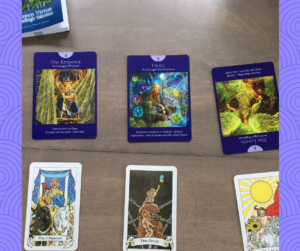
Past Present Future Character Tarot
A Character’s Past, Present, and Future in Cards

Which was happening with The Fractured Man.

I found myself rewriting early scenes and struggling with momentum. I finally realized it was because I didn’t have a good feel for what was happening with Quille and her best friend from childhood, Caleb.

He comes to her for help after dropping out of her life when they were both twenty years old. For me (and therefore the reader) to believe Quille would do him a major favor after over a decade of silence, I needed to know how they felt about each other.

Not only right now but in the past.

Past, Present, and Future

Sometimes if you know a character well enough in the present, you can fill in the past as you go. Other times who that character was as a child makes a vast difference to who the person is now.

Think about Stephen King’s It, for instance. My love for the characters as children had a huge amount to do with why I found their story as adults compelling.

But the more I thought about Caleb and kicked around ideas in my head, the more frustrated I became. I could picture him, but I couldn’t quite get in touch with him.

So I took out some tarot card decks, which I use as creative prompts only. (Despite having written some horror fiction, I’m not a believer in the supernatural or the occult.) If you’re not comfortable with tarot decks, you can buy any sort of deck of cards with striking imagery.

I laid out a card for the past, the present, and the future from the Robin Wood tarot deck and did the same for an Angel tarot deck.

Without looking at what the cards supposedly mean, I wrote a few notes with my reaction to the images and card titles alone. I found the cards in the Future column most compelling.

Character Notes from Tarot Cards

The Sun seemed to me to portray Caleb’s whole personality. He sees himself as the center of the universe with everyone revolving around him. The upside down card The Lovers demonstrated what I saw for him in future relationships. Basically that he comes at love, friendship, and family relationships in an upside down way. Looking for what he can get first and then wondering why he doesn’t feel close with anyone.

From there I moved to the past and then the present. Though I’d thought I might write about his friendship with Quille, in the end I wrote only about Caleb.

Have I solved every issue, and filled in every blank, for Caleb? No. But it’s enough that I feel confident that I can keep writing from where I am, which is about one-fifth through the story.

What are your favorite ways to learn more about your characters?

That’s all for today. Until next Friday–

L.M. Lilly

P.S. Looking for more help creating characters? Download Free Character Creation Worksheets.
Happiness, Anxiety, and Writing

Do you wake at night, stomach churning, worrying you said the wrong thing to a family member, forgot to do something vital, or failed to prepare enough for tomorrow’s meeting with your boss?

Do you ask yourself What If something awful happens over and over even if you know it’s unlikely?

When you finally get a day off does a worry about work, family, or your latest novel make it hard to enjoy yourself?

You’re not alone.

Anxiety and Creativity

Happiness Anxiety And Writing Book Cover

Many writers and other creative people, including me, feel that way.

Sometimes the creative part of your brain –  exactly what helps you write stories and imagine scenes – goes into overdrive when it comes to daily life. The writer’s imagination we value so much can, unfortunately, also trap us in endless loops of anxiety.

That’s something I’m very familiar with.

Rewriting Your Life

For years I struggled with anxiety, and the more I tried to think my way out of it, the worse it got.

But it doesn’t need to be that way.

My new book, Happiness, Anxiety, and Writing: Using Your Creativity To Live A Calmer, Happier Life (Kindle, Workbook) shares ways I learned to use imagination and my writing skills to become calmer and happier instead.

In it you’ll learn:

  • Techniques to derail anxious thoughts you otherwise repeat
  • Ways to talk to yourself and others that promote calm rather than reinforce worry
  • Specific, targeted exercises to direct your creative mind and imagination in a positive way
  • How and when to write and rewrite the best parts of your life for greater happiness
  • And more

Part memoir, part How To, Happiness, Anxiety, and Writing explains clear, simple steps to lower anxiety and stress, solve problems, and increase happiness. It includes examples from my own journey from being gripped by anxiety to a more relaxed, healthier life.

If you struggle with anxiety or worry, I hope you’ll check it out.

That’s all for today. Until next Friday–

L.M. Lilly

P.S. Happiness, Anxiety, and Writing: Using Your Creativity To Live A Calmer, Happier Life is available in a Workbook edition. Or download today in ebook format at the following retailers:

Kindle

Nook

Kobo

Apple

GooglePlay

Writing Stronger Characters

A friend recently passed on a point screenwriter Tony Gilroy (the Jason Bourne series, among others) made. He said that a writer’s understanding of human behavior caps the quality of that person’s writing.

I agree.

But how do we better understand human behavior?

I’ve got a lot of ideas about that, too many for one article. For today, though, I’ll stick with one – reading other people’s life stories.

Types Of Life Stories

Overall, I read far more fiction than non-fiction. But when I’m first drafting a novel I like to read non-fiction and, particularly, people’s life stories.

Life stories come in three basic varieties:

  • Biography
  • Autobiography
  • Memoir

Autobiography and Memoir are really subsets of Biography. Also, the lines between them can blur.

But for simplicity’s sake I’ll talk a little about each separately.

Biographies

A biography is a person’s life story told by someone else.

Biographies are usually based on research and source materials such as interviews, letters, original manuscripts, books, newspaper articles, etc.

I like biographies specifically because the author draws from multiple sources. That means getting different points of view about the life story that’s presented.

You might get a glimpse into how a daughter, a chief of staff, or a leader of a foreign state saw the President of the United States in a certain timeframe. Each of those people no doubt will interpret the president’s behavior in different ways, attributing different motives to the action and having different reactions.

Also, a biographer often stands at a distance and places the subject’s life in a broad context.

I like reading biographies of people I both agree and disagree with. After the 2008 U.S. Presidential campaign I read books about Barack Obama, John McCain, Hillary Clinton, and Sarah Palin.

Autobiographies

Typically told in first person, in an autobiography the author writes about her or his own life.

Unlike memoirs, which I’ll talk about next, an autobiography is usually pretty wide ranging. It covers the author’s real life to date. The author usually shapes the story in a creative way so it has a narrative, but the idea is to stay fairly true-to-life and include from childhood on.

If the author/subject is a public figure, I like comparing the long-term perspective of the autobiography to what the author said at the time in news reports or interviews. (Or if it’s a contemporary figure, on social media.)

Memoirs

In contrast to autobiographies, memoirs typically are narrow in scope. Rather than trying to tell a complete life story, the author collects personal memories connected by a specific emotional experience or theme.

For example, last fall I read Educated.

The memoir traces a young woman’s journey from being home schooled in a family that takes an isolated, survivalist approach to life to earning advanced degrees and choosing a vastly different life from the way she was raised.

A memoir’s tone is often less formal than an autobiography. When I read one I usually feel I get a better sense of who the author is and how that person speaks and thinks. Memoir writers often employ a bit of poetic license, combining characters, using pseudonyms to protect others’ privacy, and including dialogue as best as they can remember.

What crosses the line from fact to fiction often creates controversy.

Of the three forms, I find memoirs go deepest into the point of view of the author/subject. Maybe for that reason, memoirs feel more immediate than either biographies or autobiographies.

Putting It All Together

Here’s why I feel reading people’s life stories helps me create more well-rounded characters:

  • I love getting multiple takes on the same person.

That can come from multiple sources in a biography or from reading more than one book about the same person. It makes it easier for me to imagine the many different ways my characters will see one another.

  • All three forms help me understand the points of view of people whose circumstances are very different from my own.

That makes it easier to write three-dimensional characters whose circumstances differ from what I know based on my own life and the people I’ve personally met.

  • I like to shut my eyes and imagine stepping into the shoes of each character I write.

The more life stories I read, the easier it is for me to do that.

  • Memoirs in particular expand the different ways of speaking and writing that I’m exposed to.

I find that especially helpful when writing first-person narratives. Or writing dialogue that’s unique to each character.

  • Memoirs and autobiographies challenge me to figure out how honest or accurate I feel the author is being.

That in turn pushes me to truly understand each of my characters. And to remember that a character’s stated reason for doing something, even if the character truly believes it, might be very different from the real motive.

That’s all for today. Until next Friday–

L.M. Lilly

P.S. If you’d like some help with creating characters you can download my Free Character Creation Tip Sheets.


Rewriting Our Lives For Happiness And Calm

Sometimes having a good imagination and being a good writer can increase anxiety. My own busy writer’s brain tends to circle the same thoughts, ask a lot of What Ifs, and conjure worst-case scenarios.

But all that creativity can also help us become calmer and happier, which is the subject of a new non-fiction book I’m writing: Happiness, Anxiety, and Writing: Using Your Creativity To Live A Calmer, Happier Life.

Below is an excerpt:

Using Questions Proactively

In the past when I felt anxious I looked around until I found what I thought was making me feel that way. I tried to think myself out of anxiety by asking these types of questions:

  • Why do I feel anxious?
  • What’s going wrong that’s causing these feelings?
  • What might happen today that I’m worried about?

Because it’s rare that life is perfect, there was always something that was a concern or might become one in the future. And sometimes significant things were happening that would cause anyone to feel anxious.

The problem with these questions is that if you ask them, consciously or unconsciously, you’ll likely spiral into greater anxiety. Similarly, if you’re apt to wake up feeling discouraged or in a depressed mood, these questions and their answers will likely sink you deeper into feelings of helplessness or hopelessness.

But what if instead you asked yourself:

  • What can I do this very moment to feel just a little calmer?
  • What can I do this very moment to feel just a little happier?

I included the phrases “this very moment” and “just a little” intentionally.

Those words stop my mind from pushing back and insisting that it’s impossible to be calm or happy given what I’m facing. Even in awful moments, such as after my parents’ deaths, I could almost always do something in the moment to feel just a little better.

Becoming Just A Little Calmer

When something you fear looms or you feel anxious regardless what’s happening around you try asking and answering those two questions.

To give an idea how this works I’ve listed common answers my mind gives me below.

  • Drinking a glass of water (especially first thing in the morning when I’m apt to be dehydrated)
  • Thinking of someone I care about and hoping that person will have a good day
  • Stretching (hands, wrists, shoulders, feet, any part of my body)
  • Reimagining a good moment from the day or week before
  • Writing things I’m grateful for
  • Reading a page of an encouraging book

Your answers will vary, I’m sure, from mine or from anyone else’s. But however you answer, the two questions about feeling better are likely to provoke answers of things you can do quickly. If you do them, you’ll likely feel a little calmer and happier than if you regularly ask and answer the first three questions in this article.

Sometimes you’ll find there really was nothing of concern and things are going pretty well.

You may have awakened unsettled, but the feeling was a holdover from a bad dream, a result of the chemicals that shift your body to wakefulness from sleep, or an ingrained and unconscious habit of scanning for trouble the moment you awaken (or throughout the day).

Regardless, once you feel a little better you can check in with yourself. See if there is any concern you need to address. In fact, if you make a practice of checking in it’ll reassure you that it’s fine to first get a bit calmer and then take care of whatever needs taking care of.

Happily, you’ll be more able to keep it in perspective and deal with it in a calmer frame of mind.

For example, let’s say you have a presentation that afternoon and you don’t feel fully prepared for it. Now that you’ve taken a few minutes to feel better you can decide when you can fit in preparing for that presentation. Even if you realize you have little time to prepare, you can ask yourself what’s the quickest thing that you can do to do the best job possible under the circumstances.

Intense anxiety, though, may require more than shifting your mindset….


That’s all for today. Until next Friday, when I’ll talk about how reading biographies can help you write stronger characters

L.M. Lilly

Four Ways To Overcome Your Fear Of Failure As A Writer

If you’re struggling to start writing, or to finish what you write, you may fear failure.

Asking questions like the ones below is a clue that you may have this fear, even if it’s unconscious:

  • What if I spend all this time writing and I never finish?
  • Or I start writing and find out I’m no good at it?
  • What if no one buys what I write?
  • And what if people criticize my writing or write bad reviews?

If you suspect the fear of failing might be part of what’s keeping you from setting or meeting your writing goals, here are some thoughts about overcoming it.

Redefine

Let’s start with looking at how you define a failure, and asking whether you can revise it in a way that won’t get in the way of writing.

For instance, if you define failure as failing to try something you want to do, then you can choose whether or not you fail because you can choose to try. If you write something, anything, you won’t have failed because you tried.

On the other hand, if succeeding or failing rests on other people’s actions, such as buying or not buying your books, or their reactions, such as criticizing your writing, you’ve got limited say over that. That definition of failure puts success out of your control.

So why not choose a definition that gives you the most say over your own life?

Moving Forward Despite Fear

But let’s say in your heart it matters deeply to you what others think of your writing. Redefining failure may feel like semantics.

Success to you may mean people buying your books or selling a certain amount of them or getting rave reviews. Many writers, including me, set all those goals.

The key is not pretending those things don’t matter, it’s moving forward despite those fears.

Just as I don’t let feeling nervous my first day teaching a new class keep me from doing it, you don’t need to let fear of failure keep you from writing.

You can ease yourself into this by imagining yourself writing. Take a few minutes to shut your eyes and picture yourself typing, writing in a notebook, editing pages, or holding your finished book.

Next, in real life practice writing when you feel anxious about it. Start with a journal entry or list of favorite movies if you need to. Get used to feeling afraid and writing all the same.

Odds are the feeling will fade. Before you know it you’ll be writing your novel or whatever other projects you set your heart on.

Ask New Questions

Another approach is to look carefully at the list of questions above. Add any others that spark worry about writing or make you tense.

Now write out different questions, ones designed to ease your transition into writing.

For instance, you could ask yourself:

  • Which writing project am I most excited about?
  • What do I love about spending time writing?
  • What three things can I do to improve my writing skills?
  • How can I find ways to increase my chances of selling any book I finish?
  • What do I hope readers will like best about my writing?

Each time you begin to dwell on your fears or concerns, you can ask yourself one of these types of questions. It will help redirect your mental energy toward enjoying writing and getting better at it.

Results Rather Than Failures

Finally, you can decide there are no failures, only results. (A view I’ve seen attributed to many different people, including Tony Robbins, and which has helped me the most.)

Most everything we learn in life is a process of doing something that doesn’t work, changing our approach a bit, and trying again. Whether it’s learning to walk, swim, ride a bike, or write a book that sells, most of us need to “fail” many times to learn.

Gothic horror in Chicago’s South Loop

For example, I published a novel, When Darkness Falls, in a genre I don’t otherwise write in. (Paranormal romance/gothic horror.) When I offer it free for Kindle it gets some downloads, but it rarely sells. In fact, it took two years before it earned back what I spent paying a service to convert it for Kindle and for a cover.

I could see it as a failure.

Instead, I value what I learned from it. I figured out how to publish a paperback using the KDP dashboard for the first time. It’s also the only novel I published in Kindle Unlimited. I use it to experiment with Kindle Countdown deals and free days. And it’s a good one to try out different ad platforms because any sales I do see almost certainly result from the ad.

In addition, it’s a book I wrote before my successful Awakening supernatural thriller series, though I published it after. I see a progression in my writing from that book to the Awakening series to my newest suspense/mystery series.

As another example, I once told my brother Keith, who has loved taking photos all his life, how my favorite photos of myself (and pretty much anyone else) were ones he took. I asked him how he did it.

He said, “You don’t see the thousands I throw away.”

This was back when all photos were taken on film, meaning he spent money on the film and processing for each one. He could easily have viewed all those thrown-out photos as failures and let that stop him. If he had, he’d never have produced so many images that have made so many people happy.

He also wouldn’t be the excellent photographer he is today.

By seeing the results of his efforts, adjusting his approach, and choosing the best photos, he succeeded in his goals.

That’s all for today. Until next Friday–

L.M. Lilly

P.S. This article is based on an excerpt from the latest draft of my new non-fiction book Anxiety, Happiness, and Writing: Using Your Creativity To Live A Calmer, Happier Life. To get a notice when it’s released (as well as a Free Story Structure Worksheet), join the Writing As A Second Career email list.

Easing Winter Blues While Working From Home

I get a bit blue in winter. Working from home adds to those feelings, as while I like it, it means there’s no one around to help lift my mood.

Last winter was particularly hard.

The temperature in Chicago often dropped well below zero with high winds. Many days featured nothing but gray skies. I struggled with feeling down and not very productive. I also seemed to catch every virus that crossed my path. (Not really, but it felt that way.)

This year I’m making a few changes.

If you work at home and sometimes get the winter blues, maybe these ideas will help you, too.

Your Writing Space

A few years back I finally was able to move into a place with a second bedroom that I use as a home office. As thrilled as I was to have a dedicated writing space, it took a while for it to feel right.

When I first began working from home I was more apt to write in my main living/dining room. There were more windows and I felt less like I’d been banished to a far corner all day.

Gradually, though, I’ve shifted to working mainly in my office.

The color of the walls is a warm apricot (see photo below). It helps me feel warmer on chilly days. And I discovered that if I shut the door, the room stays warmer than my main room because it has fewer windows and more inside walls. So it turns out that keeping the door closed, rather than making me feel cut off as I’d feared, makes me feel cozy.

Finally, I just bought the lamp you see in the picture.

I have another office lamp and had been using that and an overhead light that glared. While this new tulip lamp doesn’t shed a lot of light, I love it.

Sunset occurs around 4:45 p.m. these days in Chicago. Turning on this spring-like lamp as the sky darkens in late afternoon helps me feel more cheerful.

It’s also great for the gloomy, gray days that are often a trademark of January, February, and March where I live.

Happily, the lamp, which I got through Home Depot, was only about $20 more than the plain banker’s lamp I could have gotten.

Sleeping More

I’m trying something new this winter with sleep.

Normally I’m an early to bed early to rise person. Not shockingly early, but say 6:30 or 6:45 a.m. Usually I do my best thinking mornings, and I also like to do yoga first thing. Plus in summer I find it hard to sleep later than 6:30 anyway because the sun wakes me.

In winter, though, it’s dark at 6:30 a.m. I don’t want to get out of bed.

When I worked at my law firm, I fought that and got up anyway because I had morning commitments. I carried that approach over when I started working mainly at writing. But it often left me feeling draggy (not sure that’s a real word, but it’s how I felt).

Now instead if I feel exhausted when the alarm goes off I give myself another 30 minutes. Often after 15 or so I’m awake and out of bed, and I feel much better. I’ve also shifted the time when I go to sleep to 15-20 minutes later.

So far, that’s led to me feeling more relaxed, less stressed, and happier. I think it’s because I’m not fighting what my body seems to want and need.

I’m hoping that will help me stay healthier this winter as well.

Exercising Outside

Despite disliking the cold (I know, I know, why do I live in Chicago? Because I love it all the same), I try to go outside every day and walk at least thirty minutes. Often that’s split between a walk to my business mailbox address and back or to a coffee shop and back.

It almost always helps my mood, and it helps me stay in shape.

Some days I don’t get out until late in the day, though, and those usually are the days I start feeling blue. Because of that, I now try to get out by 2 p.m. every day.

This new plan has an exception, though. Last year I went out each day despite that it was often below zero with a high windchill. This year if it’s zero or below and I’ve been out the day before, or will be out the next day, I plan to skip going outside if I don’t need to be anywhere.

Instead I’ll go down to the workout room.

There are large windows there, so I’ll be getting some light, and I can walk on the treadmill to get exercise. But I don’t need to push myself be out in the intense cold and wind that wears me down.

I’m hoping that change, too, will help me stay healthier and happier.

Seeing People In Person

Part of why I teach legal writing and research is because when the semester is in session I’m guaranteed to see people—my students and sometimes other professors—once or twice a week.

But that’s still not a lot of contact with people. Also, there are weeks when most of my work is grading papers, not meeting with students or teaching.

This year I’m trying to build in more times to get together with people in person. Last night I met with a new book group I belong to for dinner. And as I write this, I’m at a Barnes and Noble café with three other writers.

I took an L train here plus walked nearly mile in twenty-degree weather toting my laptop. From a purely time management standpoint it probably didn’t make sense. I could write as much or more at home. But it felt great to have some company. Especially because every other day this week I worked at home alone.

My other plan this year is to add one more coffee, lunch, or dinner date to my schedule that is purely social.

I already have one friend I have dinner with once a week. In the past I’ve certainly gotten together with other friends in winter but not as regularly as I want to. This year my goal is to make sure each week to see 1-3 friends whose company I enjoy.

If you have other ideas for a more cheerful winter, please let me know.

That’s all for today. Until next Friday, when I’ll talk about ways to overcome fears of failing as a writer

L.M. Lilly

3 Things To Leave Out Of Your Dialogue

Below are a few things I’ve learned to omit from dialogue to make it sound more real.

I say “sound more real” because, as I mentioned in Improving Your Dialogue, the best dialogue gives the feel of true-to-life conversation, but doesn’t duplicate it.

If it did, it’d be pretty dull.

Leave Out the Uhs and Ums

Uhs, um, likes, and you knows are words and sounds most of us say some or all of the time. Consciously or unconsciously we use them to stall for time while we think, to fill pauses, to show we belong to a social group that uses them, or simply out of habit.

Just as professional speakers strive to eliminate them, most of the time so should we as authors.

That’s because while they certainly sound realistic, using them distracts and annoys most readers. They stand out in print, where we’re not used to seeing them. Also, these filler words and sounds can make your characters sound less confident, more hesitant, or younger than you mean them to be.

Which brings me to why you should use these vocalizations some of the time.

If saying “uh” or “you know” reflects something about your character (age, nervousness, discomfort in social situations), then by all means include it. Even so, you probably don’t want to put these types of phrases or words into your character’s conversation as often as they might occur in real life.

Let’s say you’re modeling your character after someone who says “you know” in nearly every sentence.

On the page, that will probably drive your readers crazy. So you might try “you know” in one out of three or four lines of dialogue.

If you’re uncertain, find some books where you love the dialogue. See how the author handles these types of words and how often they appear, and use that as your guide.

Don’t Say Hello or Good-bye

Pay attention next time you see a phone conversation in a movie or on a television show. The actors rarely greet one another with Hello or Hi or end calls with Bye. When they’re done talking they just hang up the phone.

In real life, we’d consider these characters rude.

That’s especially so because, along with greetings like Hi or Good-bye, most of us ease into and out of conversations whether in person, by text, or by phone. Rarely do we simply walk away or hang up.

Typically one person on the phone says something like, “I should let you go.” The other responds by agreeing but typically adding something about talking again soon, or having a good week. The other person responds in kind. There’s often some sort of “take care” or “be well” back and forth and finally both parties say good-bye and hang up.

The beginnings of many conversations are similar.

Usually both people exchange Hellos and How Are Yous that go on for a minute or two before they talk about anything significant.

If you included these types of interactions in every conversation in your novel, you’d massively extend its length without furthering the plot.

You may  get in a little character development, but your readers will likely miss it, as they’ve probably taken to skimming the beginnings and endings of all the conversations.

Here are a few ways to omit these types of exchanges without making your dialogue seem unrealistic:

  • Start the scene when the conversation is already in progress
  • Summarize the beginning or end of the conversation or both
  • Include a word or two in one character’s dialogue to give the flavor of a Hello and Good-bye sequence: “Hey, Juan, I’m calling about the party.” or “I’ve heard enough. Good-bye.”

Eliminate the Is

In my Advanced Playwriting class in college (I got a Writing degree–did you guess that?) I read a scene in class. The professor, Paul Carter Harrison, wrote one of my lines on the board: “I’m sorry.”

When I finished, he said, “Nobody says ‘I’m sorry.'”

At first I was confused. I thought he meant no one ever apologized, which obviously isn’t true.

Then he explained that he meant that unless it’s a very formal situation or there’s some reason for emphasis, people say “Sorry” not “I’m sorry.”

As I started listening more to people and to myself, I realized how often we omit pronouns when talking about ourselves.

As an example, which of the two dialogue sections below sounds more realistic?

  1. “I’m sorry I’m late. I had to stop at Starbucks because my mother wanted coffee.”
  2. “Sorry I’m late. Had to stop at Starbucks–Mom wanted coffee.”

Two is probably spot on for most characters.

Of course you could have a character who speaks more formally or precisely, and that person might use the phrasing in One. Also, depending on your character’s speech patterns, you might write some combination of the two.

Further, the situation matters.

At a funeral a person might well say, “I’m sorry about your mother’s death” rather than “Sorry your mom died” because the latter sounds terse for the circumstances.

But I’d start with One as a default and go from there.

That’s all for now. Until next Friday–

L.M. Lilly

3 Things To Think About Before You Write In A New Genre

Most writers read a lot, and many of us read more than one genre.

These days I mainly read suspense, thrillers, and mystery. I used to read a lot of horror and supernatural fiction. And now and then I read mainstream fiction and classics.

Liking to read multiple genres often leads to wanting to write in more than one of them.

But is that a good thing?

Before you switch genres, a few things that are worth thinking about:

Audience Size

At first it seems like a larger audience would be better. I thought so when I switched from supernatural thrillers and horror to suspense/mystery.

But a large audience presents its own challenges.

  • It’s harder to reach a very large audience because there’s no one specific place to go to find them.

Mary Higgins Clark sells a ton of books per year. So does James Patterson. Almost anyone who likes fiction has probably read at least one if not many of their novels.

Which is the problem.

People who love vampire paranormal romance will likely look for more of those types of books. They may join Facebook groups or like pages devoted to that type of fiction. Or search sites like Amazon, Kobo, or Apple Books for “paranormal romance” or vampires.

But a James Patterson or Mary Higgins Clark fan, especially one who only reads a few books a year, can simply wait for the next book. They’re bound to hear about it through an ad, a friend, or a physical book in a store window or on a shelf.

  • Lack of common interests, making it harder to engage in content marketing.

Content marketing means creating written content such as articles, blog posts, or short stories that you give away to draw in readers who might also buy your other work. This article, for example, can serve as content marketing for my non-fiction books on writing craft, though it’d be better if I sold marketing books.

But it’s hard to tell what might be a common interest of fans of major bestselling authors. Sure, Patterson fans might like other thrillers. But they also might just like Patterson.

It’s a little easier to guess related interests of people who like more niche genres.

An article about haunted houses or true-to-life spooky stories is likely to draw an audience of readers who like horror fiction.

In contrast, readers who like thrillers don’t necessarily read nonfiction about true crime, law enforcement, or real life suspense stories.

  • Many readers in popular genres only read a few books a year, and voracious readers often already read multiple series.

Readers who read 1-5 books a year probably stick with big names we’ve all heard of. And there are enough of those, at least at the moment, that there’s no need to shop around for a lesser known author.

That’s not to say there aren’t voracious readers in popular genres like mysteries. Many of them, though, already read multiple series by multiple authors. They’ll try a new author, but typically only when they want a break from existing series or if something truly catches their eyes.

In genres with smaller audiences, voracious readers are often more excited to find another author, as they may be having trouble feeding their love of that type of book.

The flipside of all of the above is that if you do get your books to catch on, you can potentially draw in a much wider audience. I gave copies of the first book in my new mystery/suspense series to my dentist, my eye doctor, and my podiatrist (might as well get something more out of breaking my foot this past Spring). They all not only read and loved it but passed it on to other people.

My supernatural thriller series, on the other hand, is one I only promote to people who definitely like that genre because many people simply don’t like that type of book. Giving them a copy is sort of like giving them homework.

So what if you have an existing fan base? Will it help you when you switch genres?

Readers Rarely Cross Genres

In a recent interview on the Science Fiction And Fantasy Marketing Podcast author Tammi LaBrecque talked about genre crossing. She said when she was young she read whatever she could get her hands on because publishers had no way to target readers specifically.

I had the same experience.

My mom had three bookshelves of books she’d bought in the 60s from a book club. They included everything from suspense to historical fiction to humorous essays. I read them all.

In addition, I used to simply wander the stacks in my local library and pull out titles at random that looked interesting. I wasn’t even looking at covers because all I could see were the spines.

Now, though, if you shop on Amazon you’re likely to see books that are similar to ones you’ve already read. Other platforms do the same. Because marketing is so targeted, and so many books are so easily available, fewer people read widely.

I love that books are easy to come by. But it also means your readers may very well not to follow you to a different genre, something I’ve been finding out the hard way this year.

Last year I more than doubled my royalty income from the previous year. I put out the last book in my Awakening Supernatural Thriller series and released two non-fiction books.

This year due to an injury and some other issues I wasn’t as productive. I did, however, put out the first novel in a new genre. It’s a suspense/mystery novel, The Worried Man, and I just released the second book in the series, The Charming Man, this week.

Given that I now have two more books for sale, I would have thought I might at least match last year’s royalties. After all, the previous series is still selling a bit and my email list has grown.

What I discovered, though, is that the readers who eagerly awaited the fourth book in the Awakening Series are not necessarily jumping right into my Q.C. Davis Series. Those who do so far have liked it, but there isn’t the same eagerness as there was for a new book in the past series.

This difference surprised me because I always thought of supernatural thrillers as a subset of suspense, thrillers, and mystery. I figured most people who read the sub-genre would read the larger genre especially from an author they know and like.

But the books are different.

My supernatural thrillers brought in the elements of ancient prophecy and philosophical questions about religion. They also were told from multiple viewpoints, quickly shifting from one to the next.

My suspense series is told in the first person, deep in the point of view of my female private eye type hero, Quille Davis. It’s still suspense and still fast-paced, but it’s a different type of suspense.

Interestingly, I’ve gotten more reader email in the seven months since The Worried Man came out than I did in the first few years with the Awakening Series. But so far it’s a much smaller reader base.

So does all this mean you should stick with your first genre especially if you have built a fan base?

Not necessarily.

Love What You Love

Story expert Lani Diane Rich often says of the fiction we consume that you should not apologize for what you enjoy. Love what you love.

I believe that’s also true with writing. Yes, if we want people to read what we write we do need to think about our readers. But it also matters what we feel excited about writing.

Most of us have or had other jobs that we don’t love the way we do writing. Perhaps we dislike those jobs at times but they pay the bills.

If you’re going to write something you don’t enjoy to pay the bills you need to weigh whether you might be better off doing that other thing for the money.

Of course, it’s not an either/or question.

The best advice I got on this point came from author Steve Barnes in a retreat group he led. He told us to think about writing as concentric circles. One is what we absolutely love to write and really enjoy, shown in the yellow circle above. The other, the green circle, is what is the most marketable. The place to aim for is where the circles overlap.

How seriously you target the overlap depends upon your goals.

If you need your writing to be a significant part of your income, you will probably want to aim for the K and M in the graphic above. If earning a lot and becoming well known is important to you, you’ll probably do your best to write all the time in the green circle.

On the other hand, if you have other sources of income you might inch farther into the yellow circle. And if you write mainly because you simply love writing, you can write anywhere you want.

There is a caveat to this, too. We don’t always know what’s the most marketable. Sometimes we’re surprised.

But if you aim generally for that overlap you can adjust from there depending on your goals.

That’s it for today. Until next Friday —

L.M. Lilly 


Learning Characterization From TV

How To Show Your Characters' EmotionsWatching TV or movies you love can help you improve characterization in your own fiction.

Screenwriters almost always show characters’ emotions through their actions and choices, not by telling the audience how the characters feel. In other words, TV and film provide lots of examples of the best side of the “show don’t tell” advice.

Show Don’t Tell

As a new writer, I often struggled with “show don’t tell” because I thought it applied to everything.  For example, let’s say my character grew up in Chicago. I thought I couldn’t simply tell the readers that through narration.

Yet no other way made much sense to me.

Writing flashbacks of the character’s childhood in Chicago struck me as time consuming and likely to bore the reader.

And putting it in dialogue seemed artificial: “As you know, Sue, I grew up in Chicago.” Or, “Say, Jamal, since you grew up in Chicago, you must know where the Sears Tower is.” (Yep, a lot of us Chicagoans still call it the Sears Tower.)

Finally a writing instructor told me “show don’t tell” mainly applies to emotions, not background facts.

Insides Or Outsides

That insight helped make my fiction less clunky. For a long time, though, I still didn’t quite grasp how to show a character’s feelings. I thought it meant revealing emotion through the physical sensations the character experienced.

So my characters’ hearts raced or their palms sweated. They heard buzzing in their ears or felt their stomachs drop.

These types of physical sensations draw readers into a character’s experience. Which is definitely stronger than saying, “She felt anxious.” But it has its limits.

For one thing, people get sweaty palms due to anything from public speaking to a driver’s exam to committing murder. (I don’t know about that last one from experience, by the way. Just guessing.)

This is where watching TV or films comes in.

Unless there’s a voiceover to share the character’s inner life, and that’s rare, emotion can’t be shown through physical sensation or narration. Instead, the screenwriter shows emotion through what the character chooses to do. (Or say, but I’ll talk about dialogue in other articles.)

Next time you watch an episode of TV or a film you find compelling, focus on what the characters do and what emotions that conveys. To get a better sense of how that works, turn off the sound.

Now let’s talk about how to apply what you see to your own writing.

Action As Characterization

Compare these examples:

  • Aaron felt scared.
  • Aaron’s heart raced.
  • Aaron locked himself in the closet and remained motionless, his back against the wall, his knees at his chest, and his hands clamped over his mouth.

The third example is the only one that works for a television show or movie. It shows Aaron’s fear solely through his actions. It’s also the most powerful.

That’s because Aaron’s actions cause the audience to infer how he feels, making them a more active part of the story. Also, to do it, they must draw on day-to-day life, where all of us guess at other people’s emotions as we interact with them. And the more interacting with a character feels like real life, the more the character feels like your reader’s friend, enemy or acquaintance.

Finally, Number 3 is powerful because it conveys information about where Aaron is and what’s likely going on around him rather than only his emotion or physical sensations.

Imagining A TV Scene

Now when I’m truly stuck on how to get my character’s feelings across to the reader, I imagine the scene as part of a television show.

For instance, when writing The Worried Man, the first book in my detective mystery series, in my first draft I included the inner physical sensations of my main character, Quille, the morning after finding her boyfriend’s dead body. They were vivid, but something was missing.

Before I revised, I shut my eyes and saw a scene as if it were on TV.

In it, Quille stands in her closet and stares at her clothes. Finally, she pulls on a T-shirt her boyfriend left there. But she freezes in the middle of doing so, breathing in the scent of it. She can’t move because she doesn’t want to go on to the next moment of life without him.

I don’t tell the readers that last part, though. I let them infer how overwhelming her grief is through her actions. Or in this case, her inaction.

Characterization Is More Than What You See

Because as novelists we can go beyond the visual I’m not suggesting you limit yourself to what the reader can see. With the written word, we get the best of all worlds. We can show a character’s inner sensations and outer actions. And we can delve into the all the senses.

Going back to the example, a novel or short story can combine 2 and 3. Aaron’s heart can race as he hides, frozen and silent, in that closet.

Why not throw in 1 as well? We don’t need it. 2 and 3 together show the audience Aaron is not just scared but petrified.

And remember to use the other senses. Television and film necessarily draw mainly on the senses of hearing and sight. But you can and should consider how the senses of touch, smell, and taste can convey emotion.

Aaron, for example, might become hyperaware of the smell of dust or stale smoke in the closet. Especially if it makes him want to cough, sniffle, or sneeze and give away his location to an intruder.

That’s all for now. See you next time.

L.M. Lilly

P.S. Looking for help with the plot of your novel? Click here for free story structure worksheets and more.

Making Your Novel A Fast Read

If you write commercial fiction or hope to, you probably want to make your novel a page turner. Plot is a big part of that. But making it a fast read is also about how easy it is to comprehend the words you write.

Of Sentences And Syllables

The Flesch-Kincaid index estimates the level of education needed to read a piece of writing.

The calculation is based on the average number of words in each sentence and the average number of syllables in each word.

Many bestselling authors write books at the fourth grade level. As did Ernest Hemingway.

Why Write Below High School Level

If you want people to read fast, writing in a way that’s easier to understand helps. Compare the amount of effort and time it takes to read a scholarly article or college textbook chapter to a non-fiction book on the best seller list about the same topic.

Which are you more likely to read for fun? Or for information for that matter?

Writing below high school level (and perhaps at a sixth grade or fourth grade level) also helps ensure your novel will be read it at all. And finished.

If you hand someone 60,000-100,000 words and the first page takes a lot of effort to read, many people won’t continue. If your reader flies through page one, though, and there’s a story hook, it’s easy to flip the page or hit the button for page two.

Also, as readers go on in the book, they’re bound to hit points where they feel tired. Or to have days when they return home exhausted.

If your novel takes a lot of mental focus, they’ll be less likely to pick it up in the first place. They’ll also be more likely to put it down in the middle.

Calculating Reading Ease

This article  explains the specific formula if you’d like to manually calculate the grade level of your work. Some word processing programs will figure it out for you. In Microsoft Word, it’s part of the information you get after you do a Spelling and Grammar check.

Some blog platforms, including Word Press, which I’m using to write this post, provide a readability analysis and tips.

You can also do an Internet search for online reading level and reading ease calculators.

Too Basic

Writing at a too-basic level can backfire. Most of us don’t want to read See Spot run. It’s boring and distracting.

But writing that’s easy to read doesn’t need to be dull. Or limit itself to three-word sentences, one-syllable words, or generic plot lines. The Grapes Of Wrath is at a 4.1 grade level. To Kill A Mockingbird scores 5.9.

Also, preferences vary from person to person and during a person’s lifetime. I sometimes like reading something a little more complex because it takes me longer. The downside of wading through dense case law in law school and in my law practice is that sometimes I fly through novels far too quickly. I want to savor them, not gulp them whole.

Other times I want a book that takes little or no effort and pulls me along. That’s especially so if I’m working through issues in a novel I’m writing.

At those times my brain tends to go into analytic mode when I read unless the book is so fast-moving it sweeps me away.

Look at your favorite books or a group of popular books in the genre in which you write. You can do a formal calculation or eyeball the sentence and word length.

Once you’ve done that, you can get a sense of where you’d like your work to be.

By the way, this article scores a 6.7 grade level.

That’s all for today. Until next Friday—

L.M. Lilly

P.S. Looking for help with your plot? Try out the Free Super Simple Story Structure worksheets.