Plot Structure And The Hunger Games (Part 1)

When I plan a novel, rather than creating a detailed outline I use a five-point story structure. In this article I’ll talk about how the book The Hunger Games illustrates the first three points.

I’ll cover the last two in next week’s article, but here’s a list of all five:

  • Story Spark
  • One-Quarter Twist
  • Mid-Point
  • Three-Quarter Turn
  • Climax

Warning: Spoilers below. So if somehow you haven’t read The Hunger Games or seen the film, do that first.

Conflict On Page 1

Before we get to the plot points, almost every good book starts with conflict on page 1. Sometimes that conflict relates directly to the main plot, sometimes not.

In The Hunger Games it does.

In the very first paragraph, Katniss realizes her little sister, Prim, has climbed into bed with their Mom. Katniss guesses Prim’s having bad dreams and isn’t surprised because, as she tells us: “This is the day of the reaping.”

While we don’t find out until later what the reaping means, we know from the very first lines that it gives Prim nightmares and worries Katniss. That conflict draws the reader into the story.

Volunteering And The Story Spark

In the beginning of a novel, the protagonist is going along with her normal life when something major changes. That change usually comes from outside and sets the entire story in motion.

That’s the Story Spark, also known as the Inciting Incident.

In The Hunger Games, while we know right away that it’s the reaping day, we still see Katniss hunting in the woods as she normally does and selling her game. Also, as awful as the reaping is, the ceremony is an annual part of life in District 12 where Katniss lives.

During the reaping ceremony the name of one girl and one boy from the district are chosen to fight in an arena to the death.

The Story Spark occurs when the name of Katniss’ little sister, Prim, is called. That happens the end of Chapter 1 on page 20, about 5% through the book.

(I’m using a paperback edition of The Hunger Games that is 374 pages long. The story doesn’t start until page 3 and the last page includes very little text, so that’s about 371 pages of story.)

The Tributes And The One Quarter Twist

Everything after the Story Spark flows logically from it. At the One-Quarter Twist (which happens, not surprisingly, right around the first quarter of the book), something outside the protagonist raises the stakes and sends the plot in a new direction.

Because of it, the protagonist must change course as well.

In The Hunger Games, responding to the Story Spark, Katniss volunteers to take her sister’s place. She then says goodbye to her family and friends and takes a train to the Capitol (the governing city) with the boy tribute from her district. We learn some of the back story between the two. Together, both grapple to understand what’s happening and take in the new and overwhelming world.

While they are wary of one another because only one tribute can survive the games, they stick close together. The team of people assigned to help them presents them as a united front.

On page 92, one-quarter of the way through the book, though, the story shifts.

Katniss meets the other tributes and begins training to beat not only them but Peeta. She can no longer afford to think of him as an ally, though they still present a united front to try to get sponsors.

The story now focuses on Katniss winning sponsors, learning survival skills, impressing the game makers, and finding safety, food, and water during the early part of the game.

More conflict occurs between her and Peeta. She mistrusts him and questions his every move. He asks to be trained separately.

The Mid-Point Reversal And/Or Commitment

At the midpoint of a well-plotted story the protagonist makes of vow or commitment to the cause, often throwing caution to the wind. The protagonist also may suffer a major reversal of fortune.

Page 183, halfway through the book, finds Katniss literally up a tree.

She climbed up to get away from the career tributes (young people who have trained all their lives to fight in the arena). She is badly injured, hungry, in pain, exhausted, and sees no way out.

This desperate situation is her mid-point reversal.

Over the next few pages, she also throws caution to the wind and commits when future ally, Rue, points out a hornets’ nest. It contains hornets whose sting, at best, causes hallucinations. Swarms of them kill.

Despite the danger to herself, Katniss saws off a branch, sending the nest plummeting to the ground.

Releasing the swarm causes two deaths, marking the first time Katniss kills anyone in the games.

This midpoint propels the story forward, which I’ll discuss more next week.

That’s all for today. Until next Friday when I’ll finish this discussion of plot and The Hunger Games

L.M. Lilly

P.S. If you’d like to know more about the five-point plot structure, or want to try applying it to an outline or rewrite of your novel, check out these Free Story Structure Worksheets.

Listening For Ideas

Finding ideas for your novel often presents a challenge. But whether you are starting a new story, are stuck in the middle, or are looking for a new plot twist listening can help.

Sounds Inside And Out

I earned a Writing/English degree from Columbia College in Chicago. During our fiction writing classes our professors often had us sit in a circle in complete silence.

The professor directed us to listen first to sounds inside the classroom and the building. Next, because our windows opened onto Wabash Avenue, a busy street, we listened for sounds from outside.

Eventually as we kept listening the city noises and sounds prompted us to imagine scenes. After 15 minutes or so of quiet the professor had us describe each of our scenes to one another. We were pushed to include not only what we saw and heard but what we (or our characters) smelled, tasted, and felt.

The last step was to write as fast as we could in our notebooks the scenes we’d imagined.

Some of the scenes sparked new stories. Others became part of ongoing projects. Still others (probably most of them) I forgot.

I admit that when I was in college this exercise struck me as being as much about filling class time (our class sessions were over 4 hours long) as about generating ideas. Since then, though, when I’ve gotten stuck I often try this exercise and it helps.

It’s also pretty relaxing.

Your Friends, Foes, And Family

Another great place to find ideas is through day-to-day conversations.

The next time you talk to a friend, family member, or coworker, practice really listening. So often during a conversation we rush to say what’s on our minds. (Now that I spend most of my time alone writing, I notice even more of a tendency to do this.)

Instead, try setting aside your own concerns and hearing what the other person says. Ask questions to encourage that person to share more about the issue, the feelings it prompts, and the circumstances around it.

You can also try taking a breath after you think the other person has finished talking and before you speak. That may allow the other person to finish a thought or elaborate on an idea. And if your conversation partner has truly finished, it will make the conversation more relaxed and comfortable for both of you.

I’m not in any way suggesting that you put these conversations directly into one of your novels. That’s an almost certain way to get people angry at you.

If you’re like me, however, you’ll find that bits and pieces of what you hear from others spark ideas about conflicts that could become novels or scenes. You can take day-to-day issues and exaggerate them or put them in other worlds, whether that literally means on another planet or simply in another profession or family situation.

Also, the more people whose points of view you truly listen to and understand the more diverse characters and situations you can create.

Listening To Strangers

I’m also a fan of listening to conversations of strangers out on the street, on the train, or in a crowded coffee shop.

I don’t sneak up on people and eavesdrop (though I admit sometimes I’m tempted). But these days given how crowded Chicago sidewalks are and how often people talk on the phone right behind me outside, on public transportation, in stores, or in restaurants, it’s often impossible not to hear. So rather than feeling constantly annoyed by it, I listen.

As with day-to-day conversations you have with people you know, overheard conversations are great sources of ideas for novels. You’ll also gradually develop a better and better sense of other people’s speech patterns.

So next time you are walking down the street, rather than putting in earbuds and listening to audio or making a phone call yourself, pay attention to what is going on around you. It may just spark a great idea for your next novel.

That’s all for today. Until next Friday —

L.M. Lilly


Your Character’s Past, Present, and Future

Usually I create an outline for a novel and race through the first draft. The resulting manuscript, as I noted in Writing The Zero Draft Of Your Novel, usually has tons of plot holes and characters who are more like stick figures.

I’m okay with that because that’s what rewrites are for.

Sometimes, though, what I don’t know about a character keeps me from moving forward.

Characters Who Don’t Drive The Story

Because I’m a fan of writing first drafts fast I don’t worry too much about side characters.

For example, in my current novel (The Fractured Man, the third in my Q.C. Davis suspense/mystery series) a character named Dan appears in an early scene. He’s a suspect in the murder at the heart of the book.

But I already know he’ll be eliminated as a serious possibility pretty early on. Also, while he’ll get in my main character Quille’s way as she investigates, doing that won’t depend on who he is as a person.

Because of that, right now he doesn’t have a whole lot of personality. Or backstory.

When I’m done with this initial draft, I’ll expand his character to fit what I need him to do and be. If he’s meant to be a red herring and mislead the reader, he may very well end up a three-dimensional, compelling character.

Sometimes readers end up loving those characters. Maybe because I have so much fun creating them after I’ve nailed down the plot.

For now, though, it’s fine for him to walk in and do what the plot requires.

The Characters Who Matter Most

Other characters, though, propel the story forward. The most obvious is the protagonist.

For The Fractured Man, my main character Quille continues from book to book. I have a good sense of who she is. For that reason, I thought I’d write the third book in the series pretty fast once I had the plot figured out. (I do a rough 5-point outline and make some notes, and usually it’s enough.)

I rarely worry about whether any one scene is exciting or dull at this early stage because it’s easier to figure out what’s working and not when I have a whole novel in front of me.

But if a major character lacks motivation, or I’m unclear how two people relate to each other and their feelings ought to drive the plot, everything falls flat.

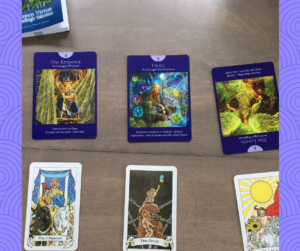
Past Present Future Character Tarot
A Character’s Past, Present, and Future in Cards

Which was happening with The Fractured Man.

I found myself rewriting early scenes and struggling with momentum. I finally realized it was because I didn’t have a good feel for what was happening with Quille and her best friend from childhood, Caleb.

He comes to her for help after dropping out of her life when they were both twenty years old. For me (and therefore the reader) to believe Quille would do him a major favor after over a decade of silence, I needed to know how they felt about each other.

Not only right now but in the past.

Past, Present, and Future

Sometimes if you know a character well enough in the present, you can fill in the past as you go. Other times who that character was as a child makes a vast difference to who the person is now.

Think about Stephen King’s It, for instance. My love for the characters as children had a huge amount to do with why I found their story as adults compelling.

But the more I thought about Caleb and kicked around ideas in my head, the more frustrated I became. I could picture him, but I couldn’t quite get in touch with him.

So I took out some tarot card decks, which I use as creative prompts only. (Despite having written some horror fiction, I’m not a believer in the supernatural or the occult.) If you’re not comfortable with tarot decks, you can buy any sort of deck of cards with striking imagery.

I laid out a card for the past, the present, and the future from the Robin Wood tarot deck and did the same for an Angel tarot deck.

Without looking at what the cards supposedly mean, I wrote a few notes with my reaction to the images and card titles alone. I found the cards in the Future column most compelling.

Character Notes from Tarot Cards

The Sun seemed to me to portray Caleb’s whole personality. He sees himself as the center of the universe with everyone revolving around him. The upside down card The Lovers demonstrated what I saw for him in future relationships. Basically that he comes at love, friendship, and family relationships in an upside down way. Looking for what he can get first and then wondering why he doesn’t feel close with anyone.

From there I moved to the past and then the present. Though I’d thought I might write about his friendship with Quille, in the end I wrote only about Caleb.

Have I solved every issue, and filled in every blank, for Caleb? No. But it’s enough that I feel confident that I can keep writing from where I am, which is about one-fifth through the story.

What are your favorite ways to learn more about your characters?

That’s all for today. Until next Friday–

L.M. Lilly

P.S. Looking for more help creating characters? Download Free Character Creation Worksheets.

Choosing Amazon Categories For Your Book

It’s hard to find time each day or week to market your books. Especially if you’re also working another job. One thing you can do once to help books sales is to add Amazon categories.

When you upload your book on the KDP Dashboard (which you can use to publish a Kindle ebook or paperback edition) you’ll be asked to choose two categories.

But where do you check out other books in those categories?

And are you limited to just two?

Number Of Categories

About a year ago at a writing conference a speaker said that if you contact KDP support, you can request a total of up to ten categories. So that’s eight in addition to the original two.

While I haven’t found an official rule confirming that, when I’ve requested additional categories, they’ve been added.

You do that through the KDP Help once you’re signed into KDP. You need to provide the ASIN for the Kindle edition of the book, its title, and the categories.

What’s New

The first time I asked for additional categories, I copied them from the sales page of books that I thought were similar to mine. A KDP support person added most of them.

For a couple, the support person advised that categories had changed but added my book into similar ones.

I still think this is a good way to get ideas.

But when I requested categories this week, I discovered I hadn’t conformed with current requirements.

In my first request for my latest non-fiction book Happiness, Anxiety, and Writing: Using Your Creativity To Lead A Calmer, Happier Life, I asked for these categories:

  • Kindle Store > Kindle eBooks > Nonfiction > Self-Help > Stress Management
  • Books > Self-Help > Anxieties & Phobias
  • Kindle Store > Kindle eBooks > Health, Fitness & Dieting > Personal Health > Healthy Living
  • Kindle Store > Kindle eBooks > Health, Fitness & Dieting > Counseling & Psychology > Mental Health > Mental Illness
  • Kindle Store > Kindle eBooks > Health, Fitness & Dieting > Counseling & Psychology > Pathologies
  • Kindle Store > Kindle eBooks > Health, Fitness & Dieting > Counseling & Psychology > Mental Health > Mood Disorders
  • Books > Health, Fitness & Dieting > Mental Health > Mood Disorders
  • Kindle Store > Kindle eBooks > Health, Fitness & Dieting > Counseling & Psychology > Pathologies > Anxieties & Phobias

KDP Support responded that I needed to choose specific, current Kindle categories, which apparently I hadn’t done.

Where To Find Them

It turns out you find the current categories on the New Release page.

The email also advised that the categories are different for each Amazon company. So the U.K. might have different categories than the U.S.

On the U.S. page I found on the left hand side toward the middle a broad list of categories. Clicking on each expanded to sub-categories.

Sometimes there were multiple layers of sub-categories. I had to drill down quite a bit to get to ones that struck me as worthwhile. Doing that took me over an hour.

Better Something Than Nothing

In a perfect world I’d investigate the top books in each possible category. Ideally, my book would be similar to those in the Top 20 or so. Also, I’d want books in the Top 20 that didn’t rank so high (say in the Top 5,000 overall) that I’d need massive sales to get there.

I’d also want ones where the Top 20 books didn’t rank so low (say 200,000 and up overall) that probably no one is browsing those categories.

One Category Worked Great On a Recent Free Day

But because I’d already spent over an hour, I had other things to get done (including write), and it’s better to do something than nothing, I skipped that research.

Instead I picked what I thought were the best categories based on the topics and the number of reviews the books had. I requested the following:

  • Kindle Store : Kindle eBooks : Self-Help : Stress Management 
  • Kindle Store : Kindle eBooks : Self-Help : Happiness 
  • Kindle Store : Kindle eBooks : Health, Fitness & Dieting : Counseling & Psychology : Mental Health : Mood Disorders 
  • Kindle Store : Kindle eBooks : Health, Fitness & Dieting : Counseling & Psychology : Pathologies : Anxieties & Phobias 
  • Kindle Store : Kindle eBooks : Reference : Words, Language & Grammar : Reference 
  • Kindle Store : Kindle eBooks : Reference : Writing, Research & Publishing Guides : Writing Skills 
  • Kindle Store : Kindle eBooks : Reference : Writing, Research & Publishing Guides : Nonfiction 
  • Kindle Store : Kindle eBooks : Reference : Writing, Research & Publishing Guides : Publishing & Books 

I left researching other countries for another day.

It may not be the perfect list. But at least there will be more places where U.S. readers may come across the books.

That’s all for today. Until next Friday–

L.M. Lilly


Happiness, Anxiety, and Writing

Do you wake at night, stomach churning, worrying you said the wrong thing to a family member, forgot to do something vital, or failed to prepare enough for tomorrow’s meeting with your boss?

Do you ask yourself What If something awful happens over and over even if you know it’s unlikely?

When you finally get a day off does a worry about work, family, or your latest novel make it hard to enjoy yourself?

You’re not alone.

Anxiety and Creativity

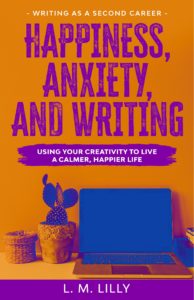
Happiness Anxiety And Writing Book Cover

Many writers and other creative people, including me, feel that way.

Sometimes the creative part of your brain –  exactly what helps you write stories and imagine scenes – goes into overdrive when it comes to daily life. The writer’s imagination we value so much can, unfortunately, also trap us in endless loops of anxiety.

That’s something I’m very familiar with.

Rewriting Your Life

For years I struggled with anxiety, and the more I tried to think my way out of it, the worse it got.

But it doesn’t need to be that way.

My new book, Happiness, Anxiety, and Writing: Using Your Creativity To Live A Calmer, Happier Life (Kindle, Workbook) shares ways I learned to use imagination and my writing skills to become calmer and happier instead.

In it you’ll learn:

  • Techniques to derail anxious thoughts you otherwise repeat
  • Ways to talk to yourself and others that promote calm rather than reinforce worry
  • Specific, targeted exercises to direct your creative mind and imagination in a positive way
  • How and when to write and rewrite the best parts of your life for greater happiness
  • And more

Part memoir, part How To, Happiness, Anxiety, and Writing explains clear, simple steps to lower anxiety and stress, solve problems, and increase happiness. It includes examples from my own journey from being gripped by anxiety to a more relaxed, healthier life.

If you struggle with anxiety or worry, I hope you’ll check it out.

That’s all for today. Until next Friday–

L.M. Lilly

P.S. Happiness, Anxiety, and Writing: Using Your Creativity To Live A Calmer, Happier Life is available in a Workbook edition. Or download today in ebook format at the following retailers:

Kindle

Nook

Kobo

Apple

GooglePlay

Author Marketing: What’s Different About You?

A marketing coach told me when I was a full-time lawyer that I ought to tell clients about my fiction writing. All of them met and dealt with skilled attorneys all the time, but a very small number of those attorneys also wrote books. What was different about me, he said, was what clients–and potential new clients–would remember.

He was right.

I’ve been thinking about how this same concept applies to marketing novels and non-fiction.

So Many Books

With millions of books on Amazon alone, and new authors releasing work every day, it takes more than a good book to stand out from the crowd.

I’ve been exploring advertising, but I don’t think that alone is enough. Also, I want to connect in a more personal way with readers. Artificial Intelligence is advancing at a rapid rate. Soon AIs will be able to write tons of content. So a personal touch matters more than ever.

For all those reasons, I’ve been thinking about what’s different about me and how it ties into my writing.

A Song In My Heart

I started playing guitar and signing when I was in junior high. My first paid job singing was at age sixteen at the Two Way Street Coffeehouse in Downers Grove. (It’s still there.)

But I got away from playing music in my twenties for a few reasons. One was that I was working a regular job and writing novels on the side, and I only had so much time. Another was that I developed a repetitive stress injury in my hands and wrists. Faced with limited use of my hands, writing won out over guitar playing.

Since then I’ve played and sung now and then for fun but not professionally.

Writing What You Know

My music background comes into my fiction, though, and into my non-fiction.

The main character, Q.C. Davis, in my new suspense/mystery series is a lawyer, but she’s also a singer in an a cappella group. In addition, I talk about singing in my upcoming book Happiness, Anxiety, and Writing: Using Your Creativity To Live a Calmer, Happier Life. Because when anxious thoughts grab hold of me in the middle of the night and won’t let go I often sing a few bars of an upbeat song in my head to derail them.

So for my Q.C. Davis series, I recorded myself singing a cappella the song quoted at the beginning of the second book. It was fun to do, and my readers enjoyed hearing the song. It also allowed me to post about the book on Facebook and Twitter without doing an actual sales pitch.

For the Happiness and Anxiety book I’m planning to record myself playing and singing Keep On The Sunny Side, one of the songs I use to derail those anxious thoughts.

I’ve got some practicing to do before then, and my guitar desperately needs new strings, but I’m hoping to post the video within the next two weeks.

And there’s another plus — guitar strings became a tax deductible expense.

What about you? What’s different about you that you can have fun with, tie to your writing, and share with the world?

Until next Friday–

L.M. Lilly

Author Marketing: Don’t Do What You Don’t Like

Most of us have a To Do list a mile long. And it almost always includes things that we don’t like to do.

Maybe we used to like a particular task. Maybe we never did. Either way those items keep moving from one day to the next or one month to the next, always hanging out there, weighing on us because we’re not doing them.

I find this is particularly true when it comes to marketing.

Building Your Platform

Whatever kind of writer you are, though, and however you publish marketing is likely to be key to your career. A big part of that is building your author platform. (Jane Friedman defines your author platform as your “ability to sell books because of who you are or who you can reach.”)

And so many tasks go into building a platform.

Here are just a few you might have tried or that might be on your list:

  • building and regularly updating an author website
  • interacting on social media
  • staying in direct touch with fans, potential fans, and readers
  • networking with other authors and professionals who might be able to help you and whom you might be able to help
  • book signings
  • other types of public speaking or personal appearances

In addition, a lot of writers still need to work another job or have multiple other responsibilities.

Shortening The List

When I’m feeling overwhelmed often my answer is to try to power through my list. Like it or not, if I decided a particular task is one most successful authors do I feel like I need to keep it on my list.

So it was with great relief when I heard Jim Kukral of the Sell More Books Show say this week that if you don’t like something relating to marketing don’t do it.

When I thought about it, that made a lot of sense.

If you don’t like something, it will probably take you more time to do than focusing on something that achieves the same purpose but that you enjoy. You’re also less likely to be effective, or come across as genuine, if you’re trying to engage with readers in a way that’s not fun for you.

Finally, what works for one author doesn’t necessarily work for someone else. So why push yourself to do that thing that you keep moving from one week to the next (or one month to the next) on your To Do list.

Changes And Social Media

What you enjoy or don’t can change.

As an example, when I first started using Twitter, I loved it. I was working 10 or so hours a day (sometimes including weekends) at my law practice. Twitter was a nice way to take a break for 5-10 minutes a few times each day.

I connected with other writers, shared blog posts I’d written, and found content that helped me in my writing and publishing journey. It reminded me that I was also a writer in addition to being a busy (and often super-stressed) lawyer. It’s how I first came across The Creative Penn, which is now my favorite podcast on publishing and writing.

I also met terrific people who made a huge difference in my career.

Women’s fiction author Melissa Foster and I connected when I had only one book out, my first supernatural thriller, The Awakening, Book 1. Melissa included it in one of the first book launches she organized. We advertised that launch mainly through Twitter.

That experience was key to me learning more about how to present my e-books and introduced me to other authors that I still keep in touch with to this day.

I also met Shiromi Arserio. She later produced and narrated three of the audiobooks in my Awakening Series. We bonded over a shared love of Buffy the Vampire Slayer. We traded blog posts, proofread each other’s manuscripts, and became friends. The last time she was in Chicago, I got to meet her in person.

Over the last year or two, though, scheduling tweets is one of those things that keeps moving from one To Do list to the next. I’m just not as excited about spending time there. While I still check in with people that I already know, it’s been a long time since I met anyone new through Twitter. And there’s so much content out there now that my issue is scaling back on what I read and listen to rather than searching for insights and information.

Finally, I see a lot more angry and frustrated tweets these days about politics. I’m all for people sharing their viewpoints, but Twitter no longer serves as an escape for me.

All this is not to say I’m abandoning Twitter.

But I decided to stop feeling guilty if I don’t go there a lot. I’ll post the articles from this page and other occasional updates. I’ll see what friends are tweeting. But otherwise I’ll probably let it go.

What Do You Enjoy?

Without particularly planning it I’ve found myself spending more time on Instagram.

I like it because it’s very different from when doing the rest of the day. Rather than sitting in front of a laptop I use Instagram on my phone. Also, rather than writing more words, which I do the rest of the day, I’m looking at or taking photos. I really enjoy using that visual part of my brain.

Also, because I haven’t been on Instagram that long and I’m pretty particular about who I follow everything I see there is something I find inspiring or encouraging or striking or peaceful. Or that makes me think in a new, interesting way.

Is it as good for marketing?

I’m not sure, but maybe that’s the point. I connected the most with readers and other authors on Twitter when I was enjoying it for what it was rather than saying to myself “time to market.” So I figure that’ll be the case for Instagram too.

Anyway, it’s fun.

Have you been struggling with something on your to do list? If so, can you let it go and do something else instead might serve the same purpose?

That’s all for today. Until next Friday—

L.M. Lilly

Writing Stronger Characters

A friend recently passed on a point screenwriter Tony Gilroy (the Jason Bourne series, among others) made. He said that a writer’s understanding of human behavior caps the quality of that person’s writing.

I agree.

But how do we better understand human behavior?

I’ve got a lot of ideas about that, too many for one article. For today, though, I’ll stick with one – reading other people’s life stories.

Types Of Life Stories

Overall, I read far more fiction than non-fiction. But when I’m first drafting a novel I like to read non-fiction and, particularly, people’s life stories.

Life stories come in three basic varieties:

  • Biography
  • Autobiography
  • Memoir

Autobiography and Memoir are really subsets of Biography. Also, the lines between them can blur.

But for simplicity’s sake I’ll talk a little about each separately.

Biographies

A biography is a person’s life story told by someone else.

Biographies are usually based on research and source materials such as interviews, letters, original manuscripts, books, newspaper articles, etc.

I like biographies specifically because the author draws from multiple sources. That means getting different points of view about the life story that’s presented.

You might get a glimpse into how a daughter, a chief of staff, or a leader of a foreign state saw the President of the United States in a certain timeframe. Each of those people no doubt will interpret the president’s behavior in different ways, attributing different motives to the action and having different reactions.

Also, a biographer often stands at a distance and places the subject’s life in a broad context.

I like reading biographies of people I both agree and disagree with. After the 2008 U.S. Presidential campaign I read books about Barack Obama, John McCain, Hillary Clinton, and Sarah Palin.

Autobiographies

Typically told in first person, in an autobiography the author writes about her or his own life.

Unlike memoirs, which I’ll talk about next, an autobiography is usually pretty wide ranging. It covers the author’s real life to date. The author usually shapes the story in a creative way so it has a narrative, but the idea is to stay fairly true-to-life and include from childhood on.

If the author/subject is a public figure, I like comparing the long-term perspective of the autobiography to what the author said at the time in news reports or interviews. (Or if it’s a contemporary figure, on social media.)

Memoirs

In contrast to autobiographies, memoirs typically are narrow in scope. Rather than trying to tell a complete life story, the author collects personal memories connected by a specific emotional experience or theme.

For example, last fall I read Educated.

The memoir traces a young woman’s journey from being home schooled in a family that takes an isolated, survivalist approach to life to earning advanced degrees and choosing a vastly different life from the way she was raised.

A memoir’s tone is often less formal than an autobiography. When I read one I usually feel I get a better sense of who the author is and how that person speaks and thinks. Memoir writers often employ a bit of poetic license, combining characters, using pseudonyms to protect others’ privacy, and including dialogue as best as they can remember.

What crosses the line from fact to fiction often creates controversy.

Of the three forms, I find memoirs go deepest into the point of view of the author/subject. Maybe for that reason, memoirs feel more immediate than either biographies or autobiographies.

Putting It All Together

Here’s why I feel reading people’s life stories helps me create more well-rounded characters:

  • I love getting multiple takes on the same person.

That can come from multiple sources in a biography or from reading more than one book about the same person. It makes it easier for me to imagine the many different ways my characters will see one another.

  • All three forms help me understand the points of view of people whose circumstances are very different from my own.

That makes it easier to write three-dimensional characters whose circumstances differ from what I know based on my own life and the people I’ve personally met.

  • I like to shut my eyes and imagine stepping into the shoes of each character I write.

The more life stories I read, the easier it is for me to do that.

  • Memoirs in particular expand the different ways of speaking and writing that I’m exposed to.

I find that especially helpful when writing first-person narratives. Or writing dialogue that’s unique to each character.

  • Memoirs and autobiographies challenge me to figure out how honest or accurate I feel the author is being.

That in turn pushes me to truly understand each of my characters. And to remember that a character’s stated reason for doing something, even if the character truly believes it, might be very different from the real motive.

That’s all for today. Until next Friday–

L.M. Lilly

P.S. If you’d like some help with creating characters you can download my Free Character Creation Tip Sheets.


Rewriting Our Lives For Happiness And Calm

Sometimes having a good imagination and being a good writer can increase anxiety. My own busy writer’s brain tends to circle the same thoughts, ask a lot of What Ifs, and conjure worst-case scenarios.

But all that creativity can also help us become calmer and happier, which is the subject of a new non-fiction book I’m writing: Happiness, Anxiety, and Writing: Using Your Creativity To Live A Calmer, Happier Life.

Below is an excerpt:

Using Questions Proactively

In the past when I felt anxious I looked around until I found what I thought was making me feel that way. I tried to think myself out of anxiety by asking these types of questions:

  • Why do I feel anxious?
  • What’s going wrong that’s causing these feelings?
  • What might happen today that I’m worried about?

Because it’s rare that life is perfect, there was always something that was a concern or might become one in the future. And sometimes significant things were happening that would cause anyone to feel anxious.

The problem with these questions is that if you ask them, consciously or unconsciously, you’ll likely spiral into greater anxiety. Similarly, if you’re apt to wake up feeling discouraged or in a depressed mood, these questions and their answers will likely sink you deeper into feelings of helplessness or hopelessness.

But what if instead you asked yourself:

  • What can I do this very moment to feel just a little calmer?
  • What can I do this very moment to feel just a little happier?

I included the phrases “this very moment” and “just a little” intentionally.

Those words stop my mind from pushing back and insisting that it’s impossible to be calm or happy given what I’m facing. Even in awful moments, such as after my parents’ deaths, I could almost always do something in the moment to feel just a little better.

Becoming Just A Little Calmer

When something you fear looms or you feel anxious regardless what’s happening around you try asking and answering those two questions.

To give an idea how this works I’ve listed common answers my mind gives me below.

  • Drinking a glass of water (especially first thing in the morning when I’m apt to be dehydrated)
  • Thinking of someone I care about and hoping that person will have a good day
  • Stretching (hands, wrists, shoulders, feet, any part of my body)
  • Reimagining a good moment from the day or week before
  • Writing things I’m grateful for
  • Reading a page of an encouraging book

Your answers will vary, I’m sure, from mine or from anyone else’s. But however you answer, the two questions about feeling better are likely to provoke answers of things you can do quickly. If you do them, you’ll likely feel a little calmer and happier than if you regularly ask and answer the first three questions in this article.

Sometimes you’ll find there really was nothing of concern and things are going pretty well.

You may have awakened unsettled, but the feeling was a holdover from a bad dream, a result of the chemicals that shift your body to wakefulness from sleep, or an ingrained and unconscious habit of scanning for trouble the moment you awaken (or throughout the day).

Regardless, once you feel a little better you can check in with yourself. See if there is any concern you need to address. In fact, if you make a practice of checking in it’ll reassure you that it’s fine to first get a bit calmer and then take care of whatever needs taking care of.

Happily, you’ll be more able to keep it in perspective and deal with it in a calmer frame of mind.

For example, let’s say you have a presentation that afternoon and you don’t feel fully prepared for it. Now that you’ve taken a few minutes to feel better you can decide when you can fit in preparing for that presentation. Even if you realize you have little time to prepare, you can ask yourself what’s the quickest thing that you can do to do the best job possible under the circumstances.

Intense anxiety, though, may require more than shifting your mindset….


That’s all for today. Until next Friday, when I’ll talk about how reading biographies can help you write stronger characters

L.M. Lilly

Advertising Books In 2019

One of my main goals this year for my author business is to advertise books in a cost effective way and increase profits. (Books includes ebook, audiobook, and paperback editions.)

As I talked about in The Good, The Bad, And The In Between Of Advertising Dollars Spent In 2018, last year I spent a lot trying different types of advertising. Thousands of dollars, in fact. While I did see some sales from some of the ads, I feel sure at least half of what I spent did nothing to increase sales.

That’s why I decided this year to be diligent about tracking what works and doesn’t and to spend far less–unless or until I figure out what ads are generating an overall profit.

Today I sat down to figure out specific goals and dollar targets. By sharing them I hope I’ll inspire you.

Setting Specific Goals

While in early January I set a budget to keep spending in check, I hadn’t really thought about exactly what result I wanted other than to earn more than I spent.

That’s the kind of fuzzy thinking that led me astray last year. I basically threw money at the wall (okay, at Facebook, Amazon, Goodreads, and a whole lot of enewsletter listings). So long as my overall royalties per month exceeded my ad spend I figured I’d sort it out later.

(Not a great plan but, to be fair, I was recovering from a fairly serious injury and a little overwhelmed.)

What saved me from doing the same this year but with a spending limit was a  brand new podcast by Bryan Cohen called Relentless Authors Advertise. Bryan asked listeners what their goals were for their ads. I realized I had a budget but not a goal.

The Basis For This Year’s Goals 

I set my goals based on these theories and data:

  • My ratio of ad spend to sales was about 1:2 last year
  • By looking at what worked best last year and eliminating platforms I’m certain added no sales I should be able to spend less and earn more
  • If I monitor the ads carefully, I ought to be able to tweak them, increase my spending, and increase my profits throughout the year
  • Starting much lower than last year and increasing my spend gradually based on results should help me keep my expenses reasonable
  • I like setting ambitious goals

My initial idea for the entire year, after looking at last year’s results, was to limit my spending to $180 a month ($2,160 a year). I planned to split this among Amazon Ads, Bookbub Ads, and enewsletters, averaging $60 per month for each category.

After listening to Bryan’s podcast on scaling up his ad spend, though, I decided I ought to do that if I can figure out over time what’s working best.

I’m used to thinking about the amount of work and profit on a quarterly basis, which is what I did with my law firm. For that reason, I’m aiming to increase spending and profits each quarter.

Last year I spent 50 cents to earn a dollar in sales. That doesn’t mean I doubled my money, though, because I earn between 30%-70% of the sale price for each book. So this year my goal for the entire year is to spend 30 cents to earn a dollar in sales.

My ambitious sales goal is to double the average monthly sales each quarter by gradually increasing my ad spend but keeping it to 30 cents on the dollar.

In Dollars And Cents

In dollars and cents, here’s the plan/goal:

1st Quarter

  • Average monthly ad spend: $180
  • Average monthly sales: $540

2nd Quarter

  • Average monthly ad spend: $324
  • Average monthly sales: $1,080

3rd Quarter

  • Average monthly ad spend: $640
  • Average monthly sales: $2,160

4th Quarter

  • Average monthly ad spend: $1,296
  • Average monthly sales: $4,320

In addition, any time I can get a Bookbub Featured Deal I’ll take it regardless of the spending budget. Those deals always pay for themselves for my books and earn a profit. Because I can’t count on getting one, though, I haven’t factored them into the average monthly ad spend.

Stay tuned for updates once a quarter.

Also, I encourage you to check out Relentless Authors Advertise if you’re doing any advertising of your books or plan to in the future. Bryan includes useful tips and information. And he shares in detail how much he’s spending compared to his total sales, which is invaluable information.

That’s all for today. Until next Friday–

L.M. Lilly